

How to Hire Developers for Your Startup
Hiring the right developers can determine the success of your startup. This guide covers everything from defining technical requirements and choosing hiring models to evaluating candidates and managing development costs. Learn how to build a skilled, scalable team that can turn your startup vision into a successful product.
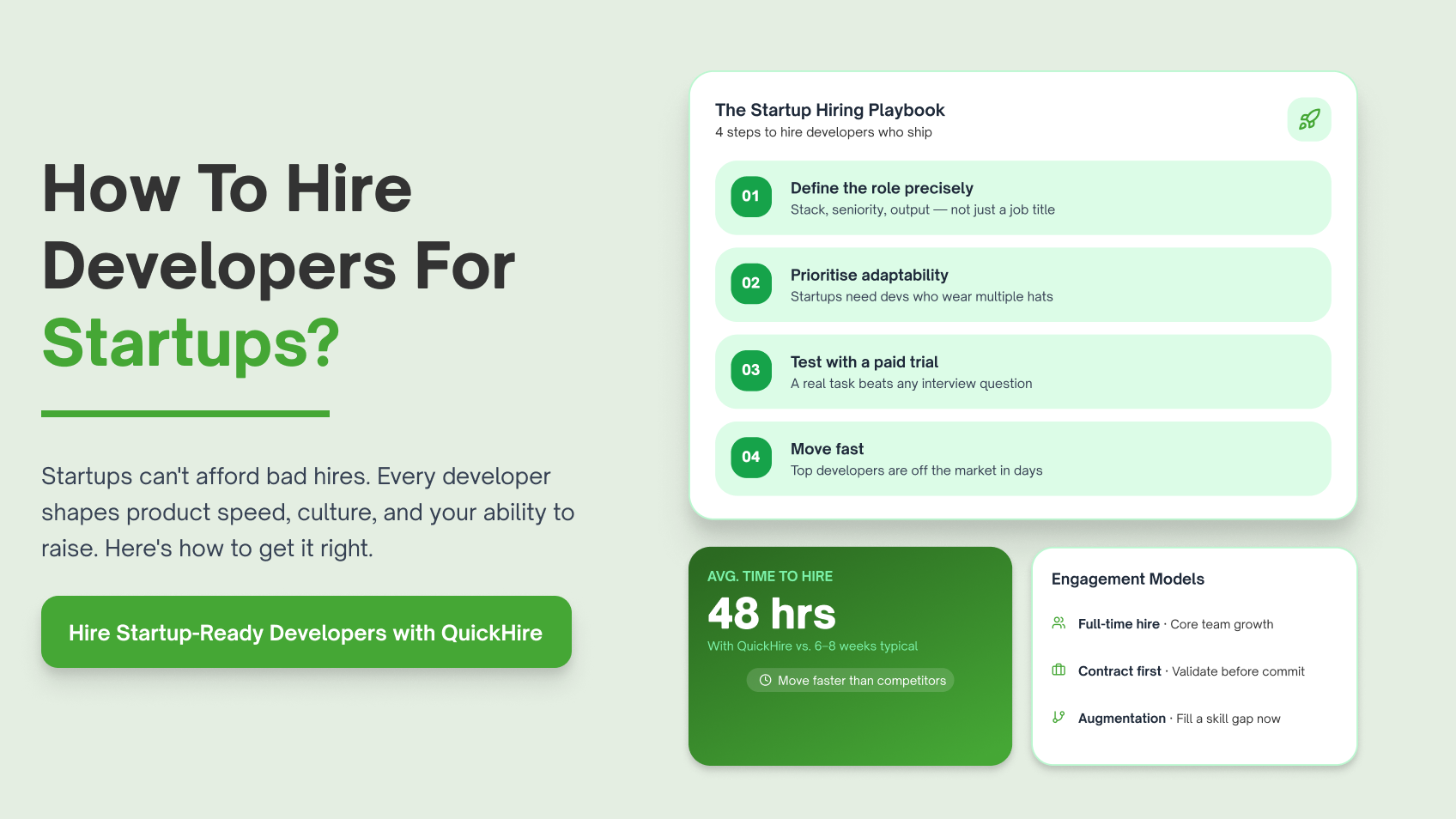
A McKinsey survey found that only 16% of executives feel comfortable with the amount of technology talent they have available to drive their digital goals. The same survey found that 60% of companies name tech talent scarcity as a key inhibitor of their transformation efforts.
That is not a startup-specific finding. That is the baseline reality across industries right now.
For a small team building its first product, it hits even harder, because every empty developer's seat is a larger fraction of your total capacity than it would ever be at a company with hundreds of people.
The hiring process itself makes things worse. According to SHRM's 2025 Recruiting Benchmarking Report, filling a position takes organizations about a month and a half on average, and that number keeps climbing. For technical roles, it routinely runs longer. Every week that passes without the right developer in the seat is a week of slower sprints, deferred releases, and your existing team absorbing a workload they were not hired to carry.
This guide covers everything a founder needs to get this right: what type of developer your startup actually needs, where to find them, how to evaluate them without a technical background, what each hiring model really costs, and why the old way of doing this is a particularly bad deal for early-stage companies.
Why Hiring a Developer Is So Hard for Startups Specifically
Large companies have brand recognition, dedicated HR teams, and salaries that can compete with the best in the market. Startups have none of these. You are trying to attract talent while competing against employers who can offer your salary three times and a name everyone has heard of.
The broader talent picture makes this harder. According to Korn Ferry's "Future of Work: The Global Talent Crunch" report, the world is on track for a shortage of 85.2 million skilled workers by 2030, which could result in $8.5 trillion in unrealized annual revenue. Technology, media, and telecoms are among the sectors hit hardest.
This is not a distant problem. It is already affecting hiring right now. For early-stage startups, the impact is acute because a single unfilled role is a larger fraction of your team than it would ever be at a company with 500 people.
The failure cost compounds things. The U.S. Department of Labor puts the cost of a bad hire at at least 30% of that employee's first-year earnings. For senior or specialist roles, that figure climbs to $240,000 or higher. And beyond the money, research consistently shows that 85% of teams experience a measurable drop in morale after a bad hire. For a startup with six people, one bad hire does not just affect one seat. It affects the whole culture, the speed of the team, and the direction of the product.
What Type of Developer Does Your Startup Actually Need?
This is the step most founders skip in their rush to write a job description. Getting it right here saves weeks of wrong conversations.
Full-Stack vs Specialist
For most pre-Series A startups, the answer is full-stack. You need someone who can build across the product without requiring five other specialists to ship a feature. Specialisation makes sense when you have a product with distinct, established layers and enough scale to justify dedicated roles. Here’s a general guide by stage:
Stage | Developer Profile |
Pre-MVP | 1 to 2 full-stack developers |
Early growth | Full-stack lead and one specialist (mobile or backend, depending on product) |
Series A and beyond | Specialised teams by function |
If you need to hire talent across multiple functions, including frontend, backend, mobile, and DevOps, it helps to have a platform where you can access verified professionals across all these roles from a single place, rather than managing separate hiring pipelines.
The Soft Skills Problem in Startup Hiring
Technical depth matters. But at an early stage, a developer who cannot communicate without jargon, who cannot work from imperfect requirements, and who does not take ownership of their output is a significant risk. Look for startup adaptability alongside technical ability.
Match the Stack Before You Post the Job
Be specific about your requirements. If your product is built on React and Node.js, hiring a .NET specialist with plans to "figure it out later" is setting yourself up for a delayed start and a costly mismatch. Map your tech requirements before a single job post goes live.
The 5 Hiring Models: Speed, Cost, and What You Actually Get
Most articles write about the cost of hiring. Almost none address the cost of hiring slowly. Every day the role is empty, productivity erodes, and competitors move. Both costs matter.
Hiring Model | Speed to Start | Annual Cost | Control Level | Best For |
In-house hiring | 35 to 45+ days | $130K to $190K/yr | High | Late-stage, long-term teams |
Freelance platforms (Upwork, Fiverr) | Days | Low to medium | Low | Simple, well-scoped tasks |
Premium networks (Toptal) | 1 to 2 weeks | Very high, minimum commitments | Medium | Quality-assured but slow and expensive |
Dev agencies | 1 to 4 weeks | High with markup | Low | Full-scope outsourced projects |
On-demand platforms (QuickHire) | 10 minutes | From $100/4hr, no lock-in | High (TPM layer included) | MVPs, sprints, urgent scaling |
Here is the number that surprises most founders: a developer hired at $150,000 through a traditional recruiter costs closer to $287,500 in year one once you factor in placement fees, onboarding time, and the productivity lost during a 45-day search.
The on-demand model exists precisely because the traditional model is broken for companies that cannot absorb that overhead.
Where to Find Developers for Your Startup
Once you know what you need, the question is where to look.
For research and discovery:
GitHub is the best starting point. Look at commit history, live deployed projects, and README quality, not just profile descriptions
LinkedIn and Stack Overflow Jobs for active candidates
AngelList Talent and Y Combinator's job board for startup-minded developers
For freelance or short-term work:
Upwork and Fiverr work for small, clearly scoped tasks. They are risky for complex product development
Toptal has a more curated pool but comes with high costs and slower matching
For immediate access to verified talent:
Platforms like QuickHire that pre-vet developers and connect you within 10 minutes, not days or weeks
How to Evaluate a Developer When You Are Not Technical
This is the part with almost no hiring guide addresses properly. Most content assumes you have a CTO or technical co-founder who can review code samples. Many early-stage founders do not.
What to Look for on GitHub
You do not need to read the actual code. You need to read the signals around it:
Is there a recent commit activity, or was the last update two years ago?
Are there live, deployed projects with real URLs you can visit?
Are there varied repositories showing range, or just one tutorial project copy-pasted?
Is the README written clearly? Good developers document their work.
Resume Signals: Green Flags vs Red Flags
Green Flag | Red Flag |
Specific, measurable outcomes ("reduced API latency by 40%") | Generic buzzword lists with no context |
Real project links and live deployments | Copy-pasted project descriptions |
Consistent GitHub activity | No public work or portfolio |
Clear career narrative showing growth | Job changes every 3 months with no explanation |
Three Questions Every Non-Technical Founder Should Ask
"Tell me about a time a project changed direction mid-build. What did you do?" This reveals adaptability, which is the most important trait in an early-stage hire.
"How do you explain a technical constraint to someone who is not technical?" This reveals communication skills.
"What would you focus on in your first two weeks if we hired you tomorrow?" This reveals ownership mentality.
Why a Technical Project Manager Changes Everything
A Technical Project Manager sits between you and the developer. They translate your requirements into clear technical specifications, review code quality, catch scope creep early, and make sure what gets built matches what you asked for.
For non-technical founders, this layer removes the single biggest risk in the equation: you cannot evaluate what you cannot read. A TPM is the quality gate you would otherwise not have.
QuickHire's For Startups model includes a TPM on every engagement. The TPM connects with you within 10 minutes of booking, confirms the scope, and stays involved throughout delivery.
How QuickHire Works: From Booking to Work in 10 Minutes
Most platforms describe a hiring process that takes weeks. QuickHire is built around a fundamentally different model.
The flow looks like this:
Book a session → TPM connects within 10 minutes → Requirements confirmed → Right expert assigned → Work begins
If TPM alignment is not established before work begins, the booking is fully refundable. Once work starts, refunds no longer apply.
What the Platform Delivers
500+ vetted professionals across development, design, marketing, and DevOps
14 countries supported
4.9 star average client rating
100+ enterprises served including Quantiphi, NinjaCart, Darwinbox, CVent, and KFintech
Operating since 2020, MSME-registered, GST compliant, Form 16A issued quarterly
The Vetting Process
Every engineer on the platform passes a live debugging exercise and a stack-specific technical assessment. They are background-checked, technically assessed, and reference-verified. These are full-time professionals working exclusively through the platform, not freelancers cycling between gigs on multiple marketplaces simultaneously.
Platform Comparison
Platform | Time to Start | Vetting Standard | PM Included | Pricing |
QuickHire | 10 minutes | Live debugging + stack assessment | Yes (TPM) | From $100/4hr, no lock-in |
Toptal | 1 to 2 weeks | Top 3% screening | No | Premium, minimum commitments |
Upwork | Days to weeks | Basic tests | No | Variable + 5% fee |
Traditional agency | Weeks to months | Varies | Sometimes | High markup |
For a detailed breakdown, QuickHire has published a full comparison of Toptal vs Upwork vs QuickHire that covers pricing, vetting standards, and PM inclusion across each model.
The Session-Based Model
Pricing starts at $100 for a 4-hour session. No minimum commitments. No hidden agency fees. No surprise invoices. GST is separately invoiced at 18% and is input-tax-credit eligible. Start with 4 hours, extend if the work demands it, and close when you are done.
This matters for startups because the session-based model matches how early-stage teams actually work: in focused sprints, not 12-month employment contracts.
Technology Coverage
QuickHire supports React, Node.js, Flutter, Kotlin, Docker, AWS, Figma, WordPress, Magento, Jenkins, HTML, and 400+ AI-powered professionals across popular tech stacks.
If you need Web Development support, Mobile App Development, or specialists in AI Teams, the platform covers each of these without requiring a separate hiring process for every function.
Common Mistakes Startup Founders Make When Hiring Developers
Knowing what to avoid saves as much time as knowing what to do.
Posting a job before defining the problem. Hiring a developer before you are clear on what needs to be built is skipping the most important step. Developers cannot build a vacuum.
Optimizing for hourly rate above everything else. The cheapest option on a freelance marketplace is not a bargain if they disappear from mid-project. Accountability has a price, and in developer hiring, it is worth paying.
Skipping the trial engagement. Always start with a scoped, paid test before committing to a longer relationship. A session-based platform lets you do this without risk.
Ignoring timezone and communication overlap. Offshore teams can work exceptionally well. Teams with a 9-hour time zone gap and no overlap for synchronous communication often cannot.
Treating developer hiring procurement. You are not purchasing a commodity. The person you hire will shape the foundation of your product. That decision deserves more than a quick comparison of hourly rates.
Conclusion
Hiring a developer for your startup is genuinely hard. The talent market is tight, the process is slow by default, and the cost of getting it wrong. Whether that means a bad hire, a long vacancy, or a developer who builds the wrong thing for six months, falls entirely on a team that cannot afford to absorb it.
The good news is that most of the problems founders run into are not inevitable. They come from starting without a clear picture of what needs to be built, choosing a hiring model that was designed for large companies with long runways, or trying to evaluate technical talent without the right support structure in place.
Getting this right comes down to a few things: know what you need before you start looking, choose a model that matches your stage and urgency, and make sure there is a quality layer between you and the work, especially if you are not technical.
For Startups that cannot afford to wait six weeks and cannot afford to get it wrong, the session-based on-demand model is not just a convenient alternative to traditional hiring. For many early-stage teams, it is the only model that actually fits how they work.
If you are at the point where you need a developer and you need them now, Book Experts and a Technical Project Manager will be in touch within 10 minutes.
Frequently Asked Questions
1. How long does it normally take to hire a software developer for a startup?
Through traditional recruitment, it averages 35 to 45 days for a general software engineer and up to 12 to 19 weeks for senior roles. On-demand platforms with pre-vetted professionals can connect you with the right person within 10 minutes of booking.
2. How do I hire a developer when I am not technical?
Focus on work signals rather than resume claims. Look at GitHub activity, live deployed projects, and commit history. Ask questions about communication and adaptability rather than technical specifics. Platforms that include a Technical Project Manager in the engagement effectively remove the evaluation burden for non-technical founders.
3. What type of developer does an early-stage startup need first?
For most pre-Series A startups, a full-stack developer who can work across the product is the right starting point. Specialist roles make more sense once the core product exists and specific functions need dedicated ownership.
4. Is it better to hire a freelancer or use an on-demand platform?
Freelancers are lower cost per hour but come with higher risk of disappearing, miscommunication, and inconsistent quality. On-demand platforms with built-in vetting and a project management layer give you speed and quality without the overhead of a traditional agency.
5. What is a Technical Project Manager and why does it matter for startups?
A TPM sits between you and the developer. They translate requirements, manage delivery, review code quality, and catch problems before they become expensive. For non-technical founders, a TPM is the quality gate that makes remote and on-demand developer engagement actually work.
6. What does hiring a developer actually cost in 2026?
A US-based in-house developer costs $130,000 to $190,000 annually. A $150K developer hired through traditional recruitment costs closer to $287,500 in year one when you include placement fees, onboarding, and lost productivity during the search. Session-based platforms like QuickHire start at $100 for a 4-hour block with no long-term commitment.
7. What if the developer is not a good fit?
If TPM alignment is not established before work begins, the booking is fully refundable. The session-based model also means you are not locked in. Extend when you want to and close when the work is done.
8. Can QuickHire handle production emergencies, not just new hiring?
Yes. If your app goes down, a feature breaks before launch, or you need an urgent fix, QuickHire's Emergency Response service connects you with the right expert immediately. You can also browse specific problem types through the Fix Problems section, which covers everything from Production Outage to Mobile App Crashing to API Integration Broken.


