The API Partner Changed Something Without Notice
Your integration broke overnight, and no one on your team touched the code. Here's why API partners change without warning, and how to respond fast.
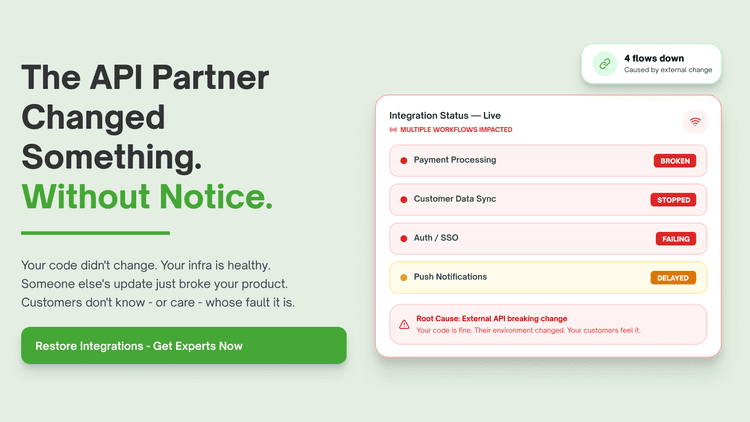
Your API partner changed something without notice. You didn't get an email. You didn't see a changelog update.
This happens constantly across custom stacks. Third-party APIs are outside your control, but your business depends on them anyway. Most teams find out only after revenue stops.
Top custom stack API partner issues and how to resolve them
Your payment processor changed its response format
You open your dashboard Monday morning. Orders are failing at checkout. Your payment gateway shows no errors on its end.
What is happening: Your processor updated its API response structure. Your code expected the old format. Parsing failed silently.
What most stores miss: Most teams assume payment APIs are stable forever. Payment processors update response schemas more often than people realize.
Business impact: Failed checkouts during a silent break can cost real revenue within hours, especially during high-traffic periods.
Industry trend: Stripe's API changelog shows version updates happen multiple times per year, often with breaking changes for older integrations.
How to fix it:
Pin your API version explicitly in every request header.
Subscribe to your processor's changelog or developer newsletter.
Add contract tests using a tool like Pact to catch format drift early.
And the worst part? You had no warning. The break looked like your own bug.
This is the step most teams skip. Forward pull: Payment isn't the only integration that breaks quietly.
A shipping API silently dropped a field you relied on
What is happening: Your shipping partner removed a field from their response. Your code expected it. Orders stopped calculating shipping costs correctly.
What nobody tells you is this: Most teams test integrations once at launch. Few retest after the partner ships an update.
Business impact: Incorrect shipping costs at checkout drive cart abandonment and customer complaints fast.
Industry trend: According to Baymard Institute research, unexpected costs at checkout are a leading cause of cart abandonment.
How to fix it:
Add schema validation on every API response, not just success codes.
Log full response payloads for thirty days to catch drift.
Set alerts for missing or null fields in critical paths.
Nobody tells you this upfront. You find out when customers complain.
Forward pull: Sometimes the change isn't in the data. It's in the rules around it.
Your API partner changed rate limits without telling you
What is happening: Requests that worked yesterday now return 429 errors. Nothing in your code changed. Your partner quietly lowered the limit.
What most stores miss: Most teams build for the rate limit listed in old documentation. Limits change more than docs get updated.
Business impact: Rate limit failures during peak traffic can block orders, syncs, or fulfillment exactly when volume is highest.
Industry trend: Research suggests undocumented rate limit changes are a common source of API related incidents across SaaS platforms.
How to fix it:
Implement exponential backoff using a library like axios-retry.
Monitor your actual request volume against current limits weekly.
Add a queue system like BullMQ to smooth out traffic spikes.
That is the part that actually hurts. The fix was simple. Nobody saw it coming.
Forward pull: Rate limits are visible eventually. Some changes hide much deeper.
Authentication tokens expired differently after a partner update
What is happening: Your integration suddenly returns 401 errors. Your tokens look valid. The partner changed how expiration works.
What most stores miss: Most teams hardcode token lifespan assumptions. Auth providers change expiration rules without major version bumps.
Business impact: Authentication failures can lock your entire integration out, stopping every dependent process at once.
Industry trend: OAuth related incidents have increased as more partners move to shorter-lived tokens, according to Okta's developer reports.
How to fix it:
Implement automatic token refresh, not manual renewal.
Store token expiration time and refresh five minutes early.
Log every auth failure with full response detail for review.
This is the step most teams skip. Refresh logic feels optional until it isn't.
Forward pull: Even authenticated requests can fail for reasons buried in fine print.
The partner deprecated an endpoint you still depend on
What is happening: An endpoint your integration calls daily returns a deprecation warning. You missed the email. The sunset date already passed.
What nobody tells you is this: Most teams don't track deprecation notices closely. Partners often bury sunset dates in developer blogs, not direct alerts.
Business impact: A deprecated endpoint going dark can break checkout, fulfillment, or sync without warning the day it happens.
Industry trend: According to Postman's State of the API report, deprecation handling remains one of the weakest areas for most engineering teams.
How to fix it:
Subscribe to every partner's developer mailing list, not just status pages.
Review API version support timelines quarterly.
Build an internal registry of every external endpoint your system calls.
Most developers know this. Most do not fix it.
Forward pull: Sometimes the partner doesn't deprecate anything. They just change the rules quietly.
Your partner updated its terms and your integration violated them
What is happening: A routine API call now returns a policy violation error. Nothing in your code changed. The partner updated usage terms.
What most stores miss: Most teams read API terms once at integration time. Terms change, and nobody reviews them again.
Business impact: A terms violation can suspend your API access entirely, halting orders or payments until resolved.
Industry trend: Research suggests API terms of service updates are increasingly used to enforce new data or usage restrictions.
How to fix it:
Assign someone to review partner terms changes every quarter.
Set up alerts for terms of service update emails.
Keep a compliance log for every third-party integration you run.
It sounds obvious. Almost nobody does it.
Forward pull: Even with policies covered, the real challenge is reacting fast enough.
You don't have anyone who can debug it fast
What is happening: The failure spans your code and the partner's API. Your team isn't sure which side broke. Hours pass before anyone makes progress.
What nobody tells you is this: Most teams have generalists on staff. API incidents often need someone who has debugged that exact partner before.
Business impact: Every hour without the right specialist is an hour of lost orders, support tickets, and customer trust.
Industry trend: According to Atlassian's incident management research, time to engage the right responder drives total downtime more than the bug itself.
How to fix it:
Build a contact list of integration specialists before an incident happens.
Document every partner API your system depends on, with contacts.
Have a fast path to bring in outside expertise on demand.
And the worst part? You had no warning. By the time you found help, hours were already gone.
The real problem behind all of these issues
Every issue above comes from the same root cause. Your business depends on systems you don't control and can't always monitor closely enough. Custom stacks make this worse because every integration is unique. The fix isn't avoiding third-party APIs. It's reacting faster when they change.
How QuickHire fixes this
When a partner API changes without warning, you need an integration specialist who has debugged similar partner outages before. QuickHire connects you in minutes. Traditional hiring takes weeks. QuickHire provides on-demand technical support for broken integrations, with a Project Manager assigned within 10 minutes.
You pay for what you use. No salary. No contract. A specialist can trace the failure to the exact API change, patch your integration, and add monitoring so it doesn't happen again.
This isn't about replacing your team's knowledge. It's about closing the gap when time matters most.
Conclusion: API partners will keep changing without notice. The right specialist can close that gap in hours, not days. Hire a vetted custom stack expert on QuickHire today. No contracts. No wait.
Frequently asked questions
Why did my API integration break with no code changes on my end?
Your third-party API partner likely changed something silently, like a response format, rate limit, or auth flow. Check your partner's changelog first, then your logs.
How do I know if a third-party API changed without telling me?
Compare current response payloads against logged historical responses. Sudden differences in structure, fields, or status codes usually point to a partner side change.
What should I do when a payment or shipping API breaks unexpectedly?
Isolate whether the failure is on your side or the partner's side first. QuickHire can connect you with a specialist who debugs this exact scenario within minutes.
How can I prevent API partner changes from breaking my integration?
Pin API versions, validate response schemas, and monitor changelogs for every partner you depend on. Contract testing catches most of these issues before they reach production.
Who do I call when an API outage affects my whole business?
Bring in an integration specialist immediately rather than waiting on your partner's support queue. QuickHire connects you with vetted custom stack experts who can debug the issue fast.