The Database Is Slowing Down During Peak Traffic
Your database slows down right when traffic peaks, and revenue is on the line. Here's why this happens on custom stacks, and how to fix it fast.
Everything Works Until Everyone Shows Up
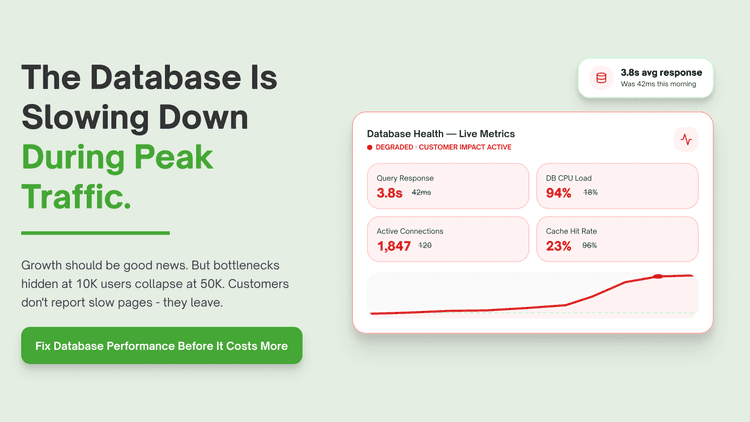
For months, the platform has been performing exactly as expected. Customers are using the product, transactions are flowing through the system, and internal dashboards show healthy growth. Then a major campaign launches. Traffic begins increasing. More users log in, more searches are performed, more transactions are processed, and more requests hit the database. At first, the changes seem manageable. Response times increase slightly, but nothing appears alarming. Then customer complaints start arriving. Pages take longer to load. Search results become inconsistent. Transactions take longer to process. Support tickets begin appearing. Suddenly, what should have been a successful growth moment turns into a performance crisis.
The challenge with database issues is that they rarely appear during quiet periods. They almost always emerge when the business needs the platform to perform at its best. A product launch, a major marketing campaign, Black Friday sales, a funding announcement, a new customer onboarding initiative, or a seasonal traffic spike can expose bottlenecks that were invisible under normal conditions. What worked perfectly for ten thousand users may struggle under fifty thousand. What seemed scalable during testing may behave very differently when real-world traffic arrives. By the time leadership becomes aware of the problem, customers are already experiencing delays.
For founders, CTOs, and engineering leaders, this creates a uniquely frustrating situation. Growth should be good news. Increased traffic should represent opportunity. Instead, infrastructure limitations begin threatening customer experience, revenue, and business momentum at exactly the moment the company should be capitalizing on demand.
When A Performance Problem Becomes A Revenue Problem
Many businesses initially view database performance as a technical issue. In reality, it quickly becomes a business issue. Modern users have little patience for slow applications. Research consistently shows that even small increases in page load times can negatively impact conversion rates, customer retention, and user satisfaction. When systems become slow during peak demand, businesses are not simply dealing with infrastructure challenges. They are risking lost sales, abandoned transactions, reduced engagement, and damaged customer trust.
The problem becomes even more severe for SaaS platforms, ecommerce businesses, fintech applications, and AI-powered products where speed directly influences customer experience. A delayed payment process can result in lost revenue. A slow customer portal can affect enterprise relationships. A lagging AI application can undermine confidence in the product. In many cases, customers don't report performance issues. They simply leave. By the time analytics reveal a decline in engagement or conversions, the business has already absorbed the impact.
Database bottlenecks are often difficult to identify because the root cause isn't always obvious. Slow queries, inefficient indexing, resource limitations, poor scaling strategies, excessive data growth, third-party integrations, infrastructure constraints, or unexpected traffic patterns can all contribute to performance degradation. The challenge is not simply fixing the problem. It's identifying it quickly enough to prevent broader business consequences.
How QuickHire Helps Businesses Scale Under Pressure
When database performance begins affecting customers, organizations rarely have the luxury of spending weeks investigating solutions. Traffic is already increasing, customers are already experiencing delays, and revenue opportunities are already at risk. Internal teams often understand the urgency but may lack the specialized expertise or available bandwidth required to diagnose and resolve the issue quickly.
This is where QuickHire helps organizations move faster. Whether the challenge involves database optimization, cloud infrastructure, DevOps engineering, backend architecture, scalability planning, performance monitoring, AI workloads, or technical project coordination, QuickHire provides access to vetted engineers, DevOps specialists, database experts, cloud architects, and technical project managers who can quickly identify bottlenecks and recommend solutions. Instead of allowing performance issues to continue impacting users, businesses can bring in experienced professionals who understand how to stabilize systems during periods of growth and increased demand. See our technical support services for database performance, with a Project Manager assigned within 10 minutes.
The value extends beyond immediate troubleshooting. Effective performance optimization creates a stronger foundation for future growth. Businesses gain better visibility into system behavior, improved scalability, and greater confidence that infrastructure can support increasing customer demand. When traffic spikes become opportunities instead of threats, organizations are better positioned to grow without compromising customer experience.
Conclusion
Database performance issues rarely arrive at convenient times. They appear when traffic is growing, customers are active, and business opportunities are at their highest. What begins as a technical slowdown can quickly impact revenue, customer satisfaction, operational efficiency, and long-term growth if not addressed quickly.
The organizations that handle these situations most effectively are not necessarily the ones with the largest infrastructure budgets. They are the ones that identify bottlenecks early, respond decisively, and access the expertise required to solve problems before customers feel the impact. Because when the database starts slowing down during peak traffic, the challenge is no longer just about technology. It's about protecting the growth that the business worked so hard to achieve.
And in today's digital economy, the ability to scale reliably is often just as important as the ability to grow.