Tech Hiring Trends 2026: AI Skills Are Everywhere and Specialists Are Hard to Find
AI skills now appear in 73% of US tech job postings, up from 15% in 2024, while software development postings fell 22%. Here's what the 2026 data says about demand, pay and hiring time, and five moves that work.
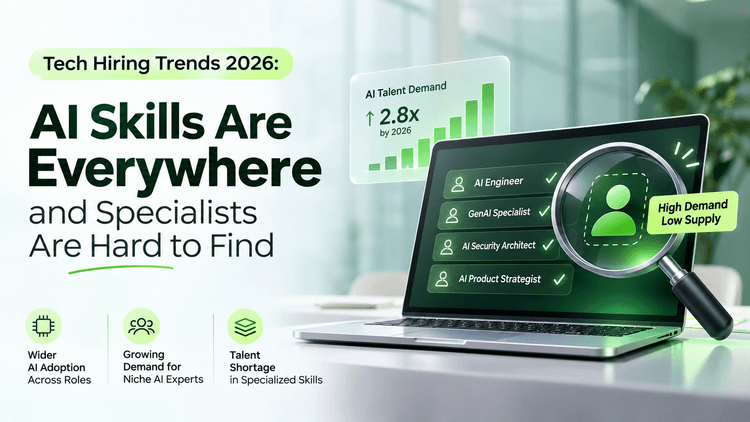
Table of Contents
73% of US tech job postings now ask for at least one AI skill. In January 2024, it was 15%. That jump explains why your last engineering search felt harder than it should have. The tech hiring trends of 2026 have changed what "qualified" means, and most job posts haven't caught up.
The market isn't cold. It's picky. Demand is piling into a narrow set of skills, pay for those skills is climbing, and the hiring process hasn't got any faster. Here's what the data says and what you can do about it this quarter.
AI skills went from bonus to baseline
Dice analyzed 7 million US tech job postings for its mid-2026 report. The share mentioning at least one AI skill rose from 15% in January 2024 to 73% in May 2026. Postings with "AI" in the job title were up 173% year over year in Q1 2026.
Read that second number carefully. It doesn't only describe AI engineers. It means the front-end developer, the QA lead and the data analyst are all being asked to work with AI tooling. Stack Overflow's 2026 developer survey, with more than 30,000 respondents, found that 73% of people who use AI coding assistants or agents use them daily. A candidate who says they "haven't really used AI tools" is no longer neutral. That's a gap you'll have to train for.
The market isn't shrinking. It's splitting.
The same Dice report found software development postings fell 22% over the period, while tech postings in finance and banking grew 47%, against 23% for tech overall. Hiring hasn't stopped. It has moved toward specific skills and toward regulated industries that are building AI into core systems.
PwC's 2026 Global AI Jobs Barometer draws the same line. It analyzed more than one billion job ads across 27 countries and found that jobs requiring specific AI skills grew roughly eight times as fast as the overall jobs market (69% versus 9%).
Our take: stop planning around "developer hiring" as one market. A general backend role and an LLM engineer role now behave like two different markets, with different timelines, budgets and candidate pools.
Junior hires are now expected to think like seniors
PwC's entry-level data (2.4 million US entry-level jobs) shows a quieter shift. AI-exposed entry-level roles are seven times more likely to ask for skills once reserved for senior people, such as judgment and leadership. Openings for those roles grew 35% since 2019, while other entry-level roles shrank 10%.
In practice, that means your graduate hire is now expected to review AI output, not just produce code. If you're still interviewing juniors on syntax puzzles, you're testing the skill AI already covers.
What AI skills now cost
PwC puts the average wage premium for AI skills at 62%, up from 57% a year earlier. In India, Quess Corp reported that pay for GenAI, MLOps and cyber threat roles rose by 10% to 40% in 2025.
If your salary bands were set in 2024, you're bidding against that premium with an old number. You can raise the band, or you can change how you fill the role. Both are valid. Doing neither is how a role stays open for three months.
Tech hiring trends in India: value over volume
Quess Corp counted 1.8 million IT roles in demand in India in 2025, up 16%. The average hiring cycle stretched to 45-60 days. Niche AI and cybersecurity roles took 75-90 days. Global capability centres (GCCs) made up about 27% of total hiring, up from 15% in 2024, so you're also bidding against the captive teams of global companies for the same engineers.
foundit's 2026 report adds three useful numbers. AI/ML, cloud and cybersecurity now drive roughly 65% of tech hiring demand. Skill-based hiring is expected to pass 70% adoption. And Tier-II cities should account for close to 40% of additional hiring. That last one matters if you've only been searching in Bengaluru and Gurugram.
Five hiring moves that work in this market
Write the role around outcomes, not years. "Ship a retrieval pipeline that answers support tickets with source links" screens better than "5+ years in Python".
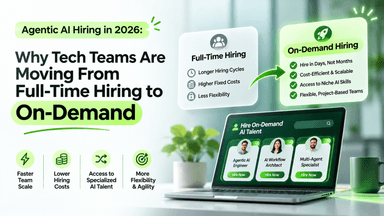
Split permanent from on-demand. Keep the people who hold your product knowledge in-house. Bring in specialists for spikes: a migration, a security audit, a first AI feature.
Put a price on every empty week. Ask finance what a one-quarter delay on that project costs. A 90-day search has a number attached, and it belongs in the budget conversation.
Test how candidates work with AI. Give them a small task, let them use any tool, and ask how they checked the output. Verification skill matters more than typing speed.
Look beyond the metros. If the work is remote-friendly, Tier-II talent widens your shortlist without a salary war.
Frequently asked questions
Which skills are in highest demand in tech hiring in 2026?
AI skills lead. Dice found that 73% of US tech job postings mentioned at least one AI skill in May 2026, up from 15% in January 2024. In India, foundit reports that AI/ML, cloud and cybersecurity drive roughly 65% of tech hiring demand.
How much more do AI skills pay?
PwC's 2026 Global AI Jobs Barometer puts the average wage premium for AI skills at 62%, up from 57% a year earlier. In India, Quess Corp reported pay rises of 10% to 40% in 2025 for GenAI, MLOps and cyber threat roles.
How long does it take to hire a tech employee in India?
Quess Corp found that the average IT hiring cycle was 45-60 days in 2025. Niche AI and cybersecurity roles took 75-90 days to fill.
Is tech hiring growing or shrinking in 2026?
Both, depending on the skill. Dice found that postings with AI in the job title rose 173% year over year in Q1 2026, while software development postings fell 22%. Demand is moving toward specialist skills rather than shrinking across the board.
How can I fill a specialist tech role quickly?
Keep the people who hold your product knowledge in-house and bring in pre-vetted experts for spikes such as a migration, a security audit or a first AI feature. QuickHire can match you with a vetted expert in as little as 10 minutes.
Fill the gap this week, not next quarter
Most of the 2026 numbers point the same way: demand for specialists is growing faster than any hiring process can keep up with. You can't speed up a labor market, but you can change how you reach it.
QuickHire keeps a bench of pre-vetted developers, designers and engineers, and it's available in 14 countries. You describe the problem, a project manager calls you back within 10 minutes during business hours, and you can be talking to a matched expert in as little as 10 minutes. No job post. No resume pile.
Tell us the role you can't fill: get matched with a vetted expert in 10 minutes →