How Much Does It Cost to Hire an App Developer in 2026?
Hiring an app developer in 2026 costs $20–$150+/hr depending on experience, location & app complexity. Basic apps start at $5K–$20K, enterprise apps exceed $300K. This guide breaks down every variable affecting your real hiring cost.
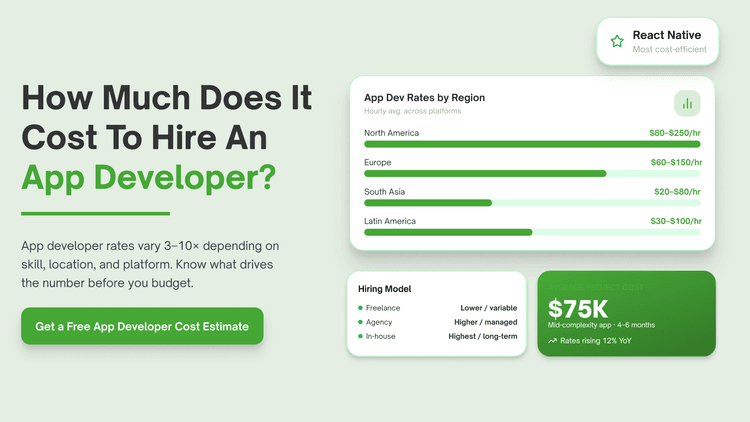
Table of Contents
In 2026, hiring an app developer typically costs between $20-$200+ per hour, depending on where they're based, how experienced they are, and what you're building. Simple apps generally run $15,000-50,000, while complex, feature-rich platforms can easily exceed $400,000. North America commands the highest rates at $110-200+/hr, while Asia offers the most budget-friendly options at $20-$40/hr.
Whether you're a startup founder with a bold idea or an enterprise looking to modernize a legacy system, the question of cost is always the first one on the table. And while the numbers above give you a starting point, the real answer lies in understanding what's actually driving those costs, so let's break that down with clarity and real numbers to guide your planning.
The Core Question: What Are You Actually Building?
Before diving into numbers, it's worth understanding that the type of engagement you need dramatically affects cost. There are generally three scenarios:
Building something new? You have an idea and need a team or developer to bring it to life from scratch. This is typically the most resource-intensive engagement.
Maintaining an existing app? Apps require ongoing updates, bug fixes, security patches, and OS compatibility work. Maintenance developers are usually engaged on a retainer or part-time basis and cost significantly less than a full build team.
Upgrading or modernizing an old system? Migrating a legacy system to a new tech stack, redesigning a dated UI, or adding new features to an older codebase. This sits between the two, it requires experienced developers who can understand existing code, which often commands a premium.
Knowing which category, you fall into before you start budgeting will save you from massive miscalculations.
What Factors Affect the Cost of Hiring an App Developer?
This is where most of the story lives. Around 80% of what determines your final bill comes down to these variables:
1. Platform Choice: iOS, Android, or Cross-Platform?
One of the biggest early decisions and one of the biggest cost levers is which platforms you want to target.
Native iOS Development: iOS apps are built using Swift or Objective-C. Native iOS developers tend to command higher rates because Apple's ecosystem requires specific expertise. If your target audience consists of premium users or you need deep hardware integration (ARKit, HealthKit, etc.), native iOS is often worth the investment.
Native Android Development: Built using Kotlin or Java. Android's broader global market share means more developers are available, which can slightly moderate costs in competitive markets. However, Android's device fragmentation (thousands of screen sizes and OS versions) can add testing overhead.
Cross-Platform Development: Frameworks like React Native, Flutter, and Xamarin allow developers to write code once and deploy on both iOS and Android. This can reduce development time by 30–40% in theory, which translates to lower cost but comes with trade-offs in performance and access to native device features. For most standard business apps, cross-platform is an excellent cost-efficient choice. For apps requiring heavy graphics, real-time processing, or deep OS integration, native is usually better.
Platform | Hourly Rate (Global Avg) | Monthly Cost (Approx) | Full App Cost Range | Best For |
iOS (Swift) | $40 0- $110/hr | $6,400 -$17,600 | $30,000 -$150,000 | Premium apps, US/iOS-focused audience |
Android (Kotlin) | $30-$100/hr | $4,800 -$16,000 | $30,000 -$150,000 | Global reach, larger user base |
Cross-Platform (Flutter / React Native) | $30 -$90/hr | $4,800 -$14,400 | $40,000 -$180,000 | Startups, MVPs, faster launch on both platforms |
2. Technology Stack
Beyond the platform, the specific technologies chosen affect both availability of talent and the rate you'll pay. Popular, well-documented stacks mean more developers are available, which tends to moderate costs. Niche or legacy technologies mean fewer qualified developers and higher rates.
Front-end/Mobile: Swift, Kotlin, Flutter, React Native, Xamarin Back-end: Node.js, Python (Django/FastAPI), Ruby on Rails, Java (Spring), Go Cloud & Infrastructure: AWS, Google Cloud, Azure Database: PostgreSQL, MongoDB, Firebase, MySQL
A full-stack developer who can handle both mobile and backend work will cost more per person but may reduce your team size. A specialized developer (e.g., a Flutter expert) may deliver higher quality for a focused scope. The right choice depends on your project's complexity.
Technology Category | Tech Stack | Hourly Rate (Global Avg) | Monthly Cost (Approx) | Best Use Case |
Mobile (iOS) | Swift | $40 -$110/hr | $6,400 -$17,600 | High-performance iOS apps, premium user experience |
Mobile (Android) | Kotlin | $30 - $100/hr | $4,800 -$16,000 | Scalable Android apps, global audience reach |
Cross-Platform | Flutter | $30 -$90/hr | $4,800 -$14,400 | MVPs, startups, faster multi-platform launch |
Cross-Platform | React Native | $30 -$85/hr | $4,800 -$13,600 | Cost-effective apps with near-native performance |
Cross-Platform | Xamarin | $35 -$90/hr | $5,600 -$14,400 | Enterprise apps using Microsoft ecosystem |
Backend | Node.js | $35 - $100/hr | $5,600 -$16,000 | Scalable, real-time apps (chat, streaming) |
Backend | Python (Django / FastAPI) | $30 -$90/hr | $4,800 -$14,400 | AI/ML apps, data-heavy platforms |
Backend | Ruby on Rails | $40 -$100/hr | $6,400 -$16,000 | Rapid MVP development, startups |
Backend | Java (Spring) | $40 -$110/hr | $6,400 -$17,600 | Enterprise-grade, secure applications |
Backend | Go (Golang) | $50 -$120/hr | $8,000 -$19,200 | High-performance, microservices architecture |
Cloud & Infra | AWS / GCP / Azure | $40 -$120/hr | $6,400 -$19,200 | Scalable infrastructure, DevOps-heavy systems |
Database | PostgreSQL / MySQL | $30 -$80/hr | $4,800 -$12,800 | Structured data, transactional systems |
Database | MongoDB / Firebase | $30 -$85/hr | $4,800 -$13,600 | Real-time apps, flexible schema |
3. Developer Experience Level
This is one of the most straightforward cost factors:
Junior Developer (0–2 years): Lower cost, suitable for well-defined tasks, requires more oversight. Good for maintenance work or augmenting a senior-led team.
Mid-level Developer (2–5 years): The sweet spot for most projects. Capable of working independently on moderately complex features.
Senior Developer (5+ years): Commands the highest rates but brings architectural thinking, code quality, and the ability to handle ambiguity. Essential for complex or high-stakes projects.
Tech Lead / Architect: Oversees technical direction. Usually engaged at a premium for larger teams or long-term projects.
Experience Level | Years of Experience | Hourly Rate (Global Avg) | Monthly Cost (Approx) | Best Use Case |
Junior Developer | 0-2 years | $15-$40/hr | $2,400-$6,400 | Simple tasks, bug fixes, maintenance, support work |
Mid-level Developer | 2-5 years | $30-$70/hr | $4,800-$11,200 | Core feature development, most standard projects |
Senior Developer | 5+ years | $50-$120/hr | $8,000-$19,200 | Complex systems, architecture, high-quality builds |
Tech Lead / Architect | 8+ years | $80-$150/hr | $12,800-$24,000 | System design, team leadership, long-term scalability |
4. Geography: Where the Developer Is Located
This is arguably the single biggest variable in developer costs. Rates can vary by a factor of 5-10x depending on the country.
United States
The US has the highest developer rates globally, driven by cost of living, high demand, and a mature tech ecosystem.
Hourly Rate: $100–$200+/hour
Monthly Retainer: $12,000–$25,000+
Best For: Companies requiring on-site collaboration, US-based legal compliance, or working in heavily regulated industries (fintech, healthcare)
United Kingdom
Rates are slightly lower than in the US but still among the highest globally.
Hourly Rate: $70-$150/hour
Monthly Retainer: $9,000-18,000
Best For: European market targeting, similar time zone advantages for UK-based businesses
Australia
Australia sits close to the UK in pricing, with a strong developer talent pool particularly in Sydney and Melbourne.
Hourly Rate: $70-$130/hour
Monthly Retainer: $8,500-$16,000
Best For: APAC market reach, high-quality output with cultural alignment for Western products
India
India is one of the world's largest sources of software development talent and offers dramatically lower rates without necessarily sacrificing quality especially at senior levels from established firms or platforms.
Hourly Rate: $15-$50/hour
Monthly Retainer: $2,000-$7,000
Best For: Cost-sensitive projects, large teams, long-term ongoing development, startups operating lean
India's developer ecosystem has matured significantly over the past decade. Many Indian developers and agencies work with Western clients daily and are well-versed in international standards. The key is vetting carefully as quality varies widely.
Quick Comparison Table
Country | Hourly Rate (Approx.) | Monthly (Full-Time Equivalent) |
USA | $100–$200 | $14,000–$25,000 |
UK | $70–$150 | $9,000–$18,000 |
Australia | $70–$130 | $8,500–$16,000 |
India | $15–$50 | $2,000–$7,000 |
Rates above reflect mid-to-senior level developers. Junior developers will fall at the lower end or below these ranges.
5. Engagement Model: Hourly vs. Monthly vs. Fixed Project
How you structure the engagement has a significant effect on total cost and risk.
Hourly Billing: You pay for time used. Best for undefined or evolving scopes, short tasks, or maintenance work. Carries the risk of cost overrun if scope creeps. Typical for freelancers on platforms like Upwork or Fiverr.
Monthly Retainer (Full-Time or Part-Time): You secure a developer's time on a recurring basis. Provides predictability and builds a working relationship. Ideal for ongoing development, long-term projects, or product teams. Common when hiring through staffing platforms or agencies.
Fixed-Price Project: You agree on a scope and pay a defined amount regardless of hours. Good for well-defined projects with clear requirements. Risk lies in under-specification- if requirements are vague, the developer may cut corners to stay within budget, or disputes arise over scope.
For most app projects beyond simple MVPs, a monthly engagement model tends to offer the best balance of flexibility and cost predictability.
6. Team Size and Composition
A single developer can build an MVP. A full product requires more:
Project Manager / Product Owner-Keeps deliverables on track
UI/UX Designer-Critical for user experience; often underbudgeted
Frontend/Mobile Developer(s)
Backend Developer
QA/Test Engineer- Essential for quality, often skipped to cut costs (a costly mistake)
DevOps Engineer- For deployment, CI/CD pipelines, cloud infrastructure
A lean 3-person team (one developer, one designer, one PM) for a simple app can deliver an MVP. A mid-complexity product typically needs 5 to 8 people. Scaling the team multiplies costs proportionally.
7. App Complexity
Simple apps (a to-do list, a basic booking form, a content display app) cost far less than complex ones. Key complexity drivers include:
Real-time features (chat, live tracking, video)
Third-party integrations (payment gateways, maps, CRMs)
Custom UI/UX animations
Offline functionality
AI/ML features
High security requirements (banking, healthcare)
Each of these adds significant development and testing time and cost.
Where Can You Find App Developers?
There are several channels to hire from, each with trade-offs:
Freelance Marketplaces:
Platforms like Upwork, Fiverr, and QuickHire connect you with independent developers. These are good for short engagements, MVPs, or specific tasks. You get flexibility and access to global talent, but vetting is your responsibility and communication can be challenging across time zones. For fixes and updates after launch, see our mobile app maintenance services on demand.
Dedicated Staffing Platforms:
Some platforms specialize in pre-vetted technical talent, reducing hiring risk for longer engagements.
Development Agencies:
Agencies handle project management, design, and development under one roof. They cost more than individual freelancers but take on more accountability for delivery.
Direct Hiring:
For ongoing products, hiring in-house (or building a remote team) provides the most control and long-term alignment, but comes with the highest fixed costs and hiring overhead.
Rough Budget Benchmarks (End-to-End Project)
To give you a sense of total project costs, not just developer rates:
App Type | Estimated Total Cost |
Simple MVP (single platform) | $15,000-$40,000 |
Medium complexity app (both platforms) | $40,000-$120,000 |
Complex app (real-time, integrations, AI) | $120,000-$500,000+ |
Enterprise-grade system | $500,000+ |
The numbers give you a general idea, but the actual cost can be higher or lower. Actual costs vary significantly based on geography, team composition, and your specific requirements.
Final Thoughts
There's no single right answer to "how much does it cost to hire an app developer" but there's a very clear framework for figuring out your answer. Start by understanding what you're building and why, then work through the factors above: platform, technology, developer experience, location, engagement model, team size, and complexity.
The biggest mistake most companies make is optimizing purely for the lowest hourly rate. The better question is: what combination of cost, quality, and speed fits your project? A $20/hour developer who takes twice as long or delivers poor code often costs more in the long run than a $60/hour developer who delivers clean, maintainable work on schedule.
Define your requirements clearly, vet your candidates thoroughly, and build for the long term - not just the launch.
FAQs
1. Is cross-platform development always cheaper than native?
Generally, yes, cross-platform (Flutter, React Native) can reduce costs by 30-40% since one codebase serves both iOS and Android. However, for apps requiring deep hardware access, heavy animations, or platform-specific features, native development may actually save money long-term by avoiding technical workarounds.
2. How much does it cost to maintain an app after launch?
A commonly cited industry estimate is that annual maintenance costs around 15-20% of the original development cost. So, a $50,000 app might cost $7,500-$10,000/year to maintain such as covering bug fixes, OS updates, security patches, and minor feature additions.
3. Hourly Billing vs. Fixed-Price Contract. Which Should You Choose?
Hourly billing gives you flexibility, ideal when requirements are likely to evolve or you're doing maintenance work. But it carries cost unpredictability. Fixed-price contracts give you budget certainty but require very well-defined requirements upfront- any scope change typically triggers extra charges. For MVPs and exploratory projects, hourly or monthly retainers work better. For clearly scoped, short-term deliverables, fixed price can save money and reduce risk.
4. How do I know if the developer I'm hiring is worth the price they're charging?
On a vetted hiring platform, developers typically go through skill assessments, portfolio reviews, and background checks before being listed. This pre-vetting reduces your risk considerably compared to open freelance marketplaces.
5. I got quotes ranging from $8,000 to $80,000 for the same app idea. How is that even possible?
The gap comes down to geography, experience, and what's actually being quoted. A cheap quote often means one junior freelancer, no design, no QA, and minimal post-launch support. The higher quote likely covers a full team with project management, testing, and a more complete product. Always ask both sides what's included before comparing numbers.
6. Do I really need to separate people for design, development, and testing, or can one developer do it all?
For a very basic MVP, one strong full-stack developer can manage, but quality usually suffers beyond that. Development, design, and QA are genuinely different skill sets, not just extra line items. Skipping dedicated testing is one of the most common ways apps fail after launch. A lean team of three, developer, designer, and QA are the practical minimum for most real projects.
7. If I hire a developer from a different time zone, how do we actually make collaboration work without constant delays?
Time zone gaps are manageable with the right structure, but they do require intentional planning from day one. The standard fix is a 2–3 hour overlap window daily for syncs, combined with async communication tools like Loom for walkthroughs and Notion or Linear for task tracking. Where it breaks down is on projects with vague requirements, a developer in a different zone can't easily ask a quick question, so they either guess wrong or sit idle.
8. How much does it cost to hire a mobile app developer?
Mobile app developers are priced by platform and seniority. A single-platform native app (iOS in Swift or Android in Kotlin) typically costs $10,000-$30,000, while a cross-platform build in Flutter or React Native is usually 20-40% cheaper because one codebase serves both stores. Hourly, mobile app developers charge roughly $20-$45/hour in India, $40-$80/hour in Eastern Europe, and $100-$150/hour in the US. Through QuickHire, a vetted mobile app developer with a dedicated project manager starts at $100 per 4-hour session (about $25/hour equivalent), with no recruitment overhead and no lock-in.
9. How much does it cost to hire a dedicated fintech app developer?
Fintech app developers command a 20-30% premium over general app developers because of PCI-DSS, SOC 2 and financial-data security requirements. Expect roughly $30-$60/hour in India and $120-$180/hour in the US, or a fixed project cost that runs 20-30% above a comparable non-fintech app. The premium buys experience with secure payment flows, KYC/AML integrations, encryption and audit-ready code - which is far cheaper than a compliance failure after launch. QuickHire matches vetted, compliance-experienced app developers with a dedicated project manager from $100 per session, so you get fintech-grade delivery without an enterprise agency retainer.
Ready to build? Explore our mobile app development services to book a vetted developer with a dedicated project manager in about 10 minutes, from $100 per session.