Agentic AI Hiring in 2026: Demand Is Up 260% and These Are the Roles to Fill First
Postings for agentic AI engineers in India are up 260% in 2026. Here are the five fastest-growing AI roles, why they take a quarter to fill, and six questions to screen candidates.
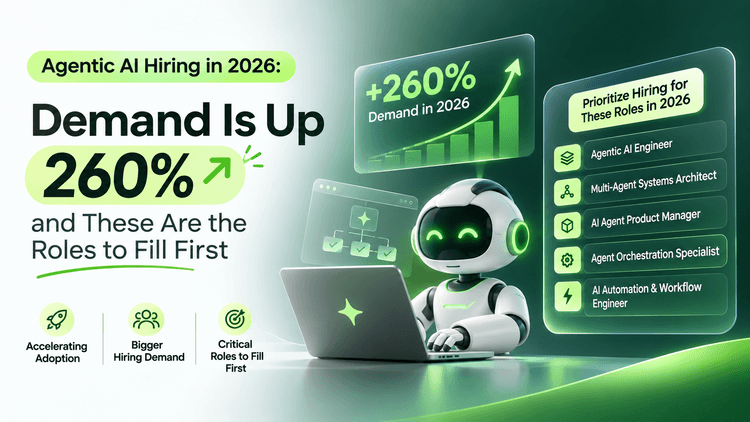
Table of Contents
Postings for agentic AI engineers in India are up 260% in 2026 compared with 2025, according to CIEL HR. It's the sharpest jump the firm tracked among emerging tech roles. If you're trying to hire for agentic AI right now, you've already felt what that does to your shortlist.
This guide covers what the role involves, which five job titles are growing fastest, why they take a quarter to fill, and how to screen candidates without a research team.
What an agentic AI engineer actually builds
A chatbot answers. An agent acts. Give an agent a goal such as "resolve this refund ticket" and it plans the steps, calls your order API, checks the refund policy, issues the refund if the rules allow it and escalates if they don't.
The engineer behind it builds the planning loop, the tool connections (often through MCP or direct API calls), the guardrails and the tests that tell you when the agent is wrong. CIEL HR estimates that AI could handle up to 70% of ticket resolution and report generation, and up to 65% of test-case creation. Those are the tasks companies are pointing agents at first. CIEL HR is clear that this doesn't mean the people in those roles disappear. It changes what they spend their time on.
Agentic AI hiring: the five roles with the sharpest demand
CIEL HR compared 2026 and 2025 postings. Its analysis draws on more than 450 million job postings and 30 million professional profiles, with posting data observed through May 2026 and projections after that. The fastest risers:
Agentic AI engineers (+260%). Build and run the agents: planning, tool use, memory and failure handling.
GenAI solutions architects (+120%). Decide where agents fit in your systems, which models to use and how data flows.
AI product owners (+120%). Define what the agent should and shouldn't do, and how you'll measure success.
LLM engineers (+86.5%). Own prompts, retrieval, fine-tuning and model selection.
MLOps engineers (+82.2%). Deploy, monitor and cost-control models in production.
Percentages from small bases can mislead, so read these as direction, not size. The direction is clear though: companies want people who run AI in production, not people who demo it. The US shows the same pattern. Dice found postings with "AI" in the title up 173% year over year in Q1 2026. If you need one of these roles now, start with our GenAI engineer page.
Why these roles take a quarter to fill
CIEL HR puts skill gaps across AI, cloud and cybersecurity at 38% to 61%. Quess Corp found that niche AI and cybersecurity roles took 75-90 days to fill in 2025, against 45-60 days for the average IT role, and that pay for GenAI and MLOps roles rose by 10% to 40%. PwC's 2026 AI Jobs Barometer puts the average AI wage premium at 62%.
So the timeline looks like this: three months to hire, then onboarding, then the build. A first agent project that had to land this quarter lands next year.
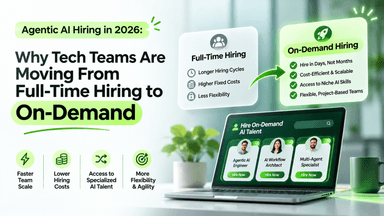
Our view: for a first agent project, don't start with headcount. Start with the build. Bring in someone who has shipped agents to production, prove the use case on one workflow, then decide what permanent team it justifies. You learn what you actually need before you pay a 62% premium for it.
The criterion nobody puts in the job post: verification
Agents fail quietly. They answer with confidence, take a wrong action or run up an LLM bill nobody expected. Stack Overflow's 2026 developer survey found that 73% of people who use AI coding assistants or agents use them daily. Yet 93% of respondents said they need source attribution to trust AI output, and 38% of organizations set limits on AI usage.
Use is far ahead of trust. So hire for the person who builds the safety net: test sets, human approval steps, cost caps and logging. If your AI feature is already giving wrong answers, our guide to fixing chatbot accuracy, prompts and costs shows where to look first.
Six questions to screen agentic AI candidates
Show me an agent you shipped. What did it do when a tool call failed?
How do you test agent output before release? What's in your test set?
Where does a human approve an action, and how did you decide that?
How do you cap cost per task? What happened to cost at 10x volume?
Which framework or protocol did you pick (LangGraph, MCP, direct API calls), and why not the others?
Tell me about an agent that failed in production. What changed afterwards?
Strong candidates answer with specifics: failure cases, test sets, costs per task. Weak ones describe demos. If you can't judge the answers yourself, have an architect sit in on the interview. One hour of that costs far less than a wrong hire.
Frequently asked questions
What is an agentic AI engineer?
An agentic AI engineer builds AI agents that plan steps, call tools and APIs, and act toward a goal. They also build the guardrails and tests that catch wrong actions before they reach customers.
How fast is demand for agentic AI engineers growing?
CIEL HR reports that postings for agentic AI engineers in India are up 260% in 2026 compared with 2025. It is the sharpest rise among the emerging tech roles the firm tracked.
Which other AI roles are growing fastest?
CIEL HR found that GenAI solutions architects and AI product owners are each up 120%, LLM engineers are up 86.5% and MLOps engineers are up 82.2%, comparing 2026 and 2025 postings.
Why do agentic AI roles take so long to fill?
CIEL HR puts skill gaps across AI, cloud and cybersecurity at 38% to 61%. Quess Corp found that niche AI and cybersecurity roles took 75-90 days to fill in 2025, against 45-60 days for the average IT role.
Should I hire full-time for my first agent project?
Often not. Bring in someone who has shipped agents to production, prove the use case on one workflow, then decide what permanent team it justifies. QuickHire can match you with a pre-vetted GenAI engineer in as little as 10 minutes.
Start with the build, not the headcount
QuickHire matches you with pre-vetted GenAI engineers for exactly this stage. Describe what the agent needs to do, and a project manager calls you back within 10 minutes during business hours. You can be talking to a matched expert in as little as 10 minutes, then decide whether the project earns a permanent team.
Tell us what your agent needs to do: get matched with a GenAI engineer →