Why Tech Teams Are Moving From Full-Time Hiring to On-Demand Experts in 2026
A normal IT hire takes 45 to 60 days, a niche AI hire 75 to 90. Here's why teams now keep a small permanent core, add on-demand tech talent for the rest, and how to decide role by role.
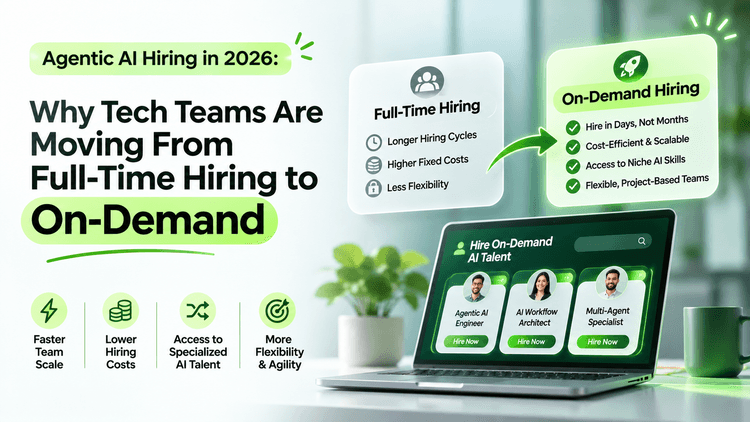
Table of Contents
A normal IT hire in India takes 45 to 60 days to close. A niche AI or security hire takes 75 to 90. Those are Quess Corp's numbers for 2025, and they add up to roughly a full quarter before the person writes a line of code.
Your roadmap doesn't wait a quarter. That gap is why more teams are keeping a small permanent core and bringing in on-demand tech talent for the work that can't wait. Here's what's driving the shift, where it stops making sense, and how to decide role by role.
The 90-day problem
Add the skills gap to the calendar. CIEL HR puts shortages across AI, cloud and cybersecurity between 38% and 61%. PwC's 2026 AI Jobs Barometer puts the wage premium for AI skills at 62%, up from 57% a year earlier. Fewer qualified people, higher asking prices, longer searches.
Say your mobile app release slips because the engineer you're recruiting is still in round three. If that delay costs you ₹1.5 lakh a week in lost orders, a 90-day search costs about ₹19 lakh before anyone's salary. The empty chair has a price. Most budget conversations skip it.
Why teams are adding on-demand tech talent
The Staffing Industry Analysts (SIA) Global Talent Platform Survey, run in June and July 2026, asked talent platforms why enterprises choose platform freelancers over traditional staffing. The top answers were faster hiring (91%), flexible project scope and timelines (84%), specialized expertise (78%) and scalability during economic uncertainty (78%).
One caveat: the respondents were platform operators, not buyers. Treat it as the sellers' view. Even so, the ranking is telling. Speed comes first, and cost isn't among the top reasons listed.
TCWGlobal's 2026 outlook on contingent labor describes the same use cases: product launches, market expansion, digital transformation and specialist projects that can't wait for a traditional hiring cycle. It also notes that many firms need outside expertise before they build permanent AI teams. That second point matters most if you're starting an AI project. You don't yet know what team the project will justify.
Supply is there, too. TCWGlobal cites Upwork research showing more than one in four US skilled knowledge workers freelancing or working independently, with independent knowledge work earning $1.5 trillion in 2024.
A reality check: on-demand isn't replacing full-time
It would be easy to write "full-time hiring is dead". The data doesn't say that. The same SIA survey reported that gross spend on talent platforms fell 2% globally to $15.3 billion last year, while the overall staffing industry grew 2%. Companies are still hiring employees.
Our take: the shift isn't from full-time to freelance. It's from one hiring model for every role to a model per role. Permanent staff hold your product knowledge. On-demand experts cover spikes, rare skills and emergencies.
A three-question test: full-time or on-demand?
Run each open role through these:
Will this work exist at the same volume in 12 months? If yes, and the knowledge needs to build up inside your team, hire full-time. If it's a migration, an audit or a launch, it ends.
Does anyone on your team already have the skill? If nobody does (LLM guardrails, Kubernetes cost tuning, a security review), a specialist for a few weeks beats a generalist learning on your time.
What does each week of delay cost? If the answer is "a lot", a 45-to-90-day search is the wrong tool.
Some examples that tend to land on the on-demand side: an app rejected by Google Play or the App Store the day before launch, a checkout that stops working mid-sale, a deployment that fails for reasons nobody can trace, an LLM feature that hallucinates in front of customers. You can browse these common problems and see how each one gets fixed.
What goes wrong when on-demand is done badly
TCWGlobal flags the risks that grow with the program: worker classification, tax documentation, co-employment risk, messy onboarding, and departments using different suppliers with no shared visibility. Add the plain engineering risk. An outside expert leaves and takes the context with them.
A short checklist keeps it clean:
Vetting done before the match, not by your team after it
A named project manager, so one person owns delivery
Written scope and acceptance criteria before work starts
NDA and IP terms in the contract
A handover document at the end, in your repo, not in someone's head
Frequently asked questions
What is on-demand tech talent?
On-demand tech talent means pre-vetted engineers, designers and specialists you bring in for a defined piece of work, such as a migration, audit, launch or urgent fix, instead of hiring a permanent employee.
How long does a normal tech hire take?
Quess Corp found that the average IT hiring cycle in India was 45-60 days in 2025. Niche AI and cybersecurity roles took 75-90 days to fill.
Why do companies choose platform freelancers over traditional staffing?
In the Staffing Industry Analysts survey of talent platforms (June and July 2026), the top reasons were faster hiring (91%), flexible project scope and timelines (84%), specialized expertise (78%) and scalability during economic uncertainty (78%).
Is on-demand hiring replacing full-time hiring?
No. The same survey reported that gross spend on talent platforms fell 2% globally to $15.3 billion last year, while the overall staffing industry grew 2%. Teams are using each model for different kinds of work.
When should I hire full-time and when should I bring in an expert?
Hire full-time for continuous work where knowledge should build up inside your team. Bring in an on-demand expert for spikes, rare skills and work where every week of delay is costly.
Keep the core. Rent the spike.
QuickHire is built for the rent-the-spike half. You tell us what's broken or what you need built, a project manager calls you back within 10 minutes during business hours, and you can be talking to a matched, pre-vetted expert in as little as 10 minutes. QuickHire is available in 14 countries.
Got work that can't wait a quarter? Book an expert now →
Sources
Angel One: India's IT job market grows 16% in 2025 (Quess Corp)
Business Today: Agentic AI engineers emerge as the hottest tech hire (CIEL HR, Sept 2026)
Staffing Industry Analysts: Talent platforms gain ground with enterprise buyers (Aug 2026)
TCWGlobal: Trends in the gig economy and contingent labor in 2026