How to Hire an AI Developer for an Urgent Production Issue ?
When a production issue involving AI threatens your business, finding the right developer quickly is critical. Learn how to hire an AI developer for urgent troubleshooting, identify the right expertise, minimize downtime, and get your AI system back on track without lengthy hiring delays.
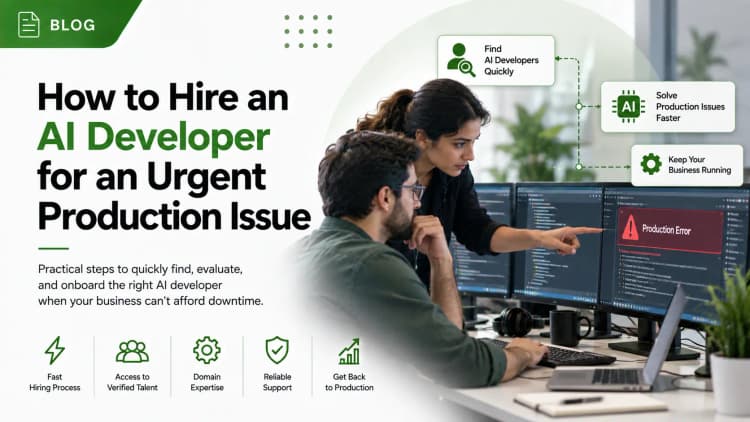
Table of Contents
If your AI system is failing in production, do not start by posting a generic “AI developer required urgently” job. First identify which layer is failing model, prompt, data, retrieval, application, infrastructure, or deployment. Then hire a specialist who has solved similar production problems before.
An urgent production issue is very different from a normal AI development project. You are not looking for someone who can simply build an AI feature or demonstrate a model. You need someone who can diagnose the failure, contain the impact, fix the underlying problem, validate the solution, and make sure the same issue does not happen again.
The fastest hiring decision is therefore not necessarily the one that gets you a developer first. It is the one that gets the right production expertise into your system before the incident becomes a larger business problem.
First, Identify What is Actually Broken
Before you hire anyone, spend a few minutes determining what has changed.
The same applies to other production issues. An AI recommendation engine may suddenly produce poor recommendations because the underlying customer data changed. An AI agent may stop completing workflows because an API permission changed.
Failure Layer | Typical Production Problem | Specialist You May Need |
Model | Accuracy suddenly drops or predictions become inconsistent | ML/AI developer |
Prompt/application | LLM produces unexpected responses after a code change | LLM/AI application developer |
RAG | Relevant information is not retrieved or responses contain unsupported claims | RAG/LLM developer |
Data | Missing, stale, corrupted, or incorrectly structured data | Data/ML engineer |
Infrastructure | High latency, crashes, resource exhaustion, API failures | AI/cloud/MLOps engineer |
Deployment | New model or application version fails in production | MLOps/DevOps engineer |
Security | Prompt injection, data leakage, access-control problem | AI security specialist |
A previously stable RAG chatbot may begin hallucinating because retrieval quality dropped after an indexing update.
A useful first classification looks like this:
What Type of AI Developer do You Need for a Production Emergency?
There is no single “AI developer” who is automatically the right fit for every production problem.
AI/ML Developer
Hire AI developers when the problem is related to model behavior, prediction quality, classification, forecasting, recommendation systems, or model performance.
They should understand model evaluation, training data, feature engineering, model versions, inference behavior, and performance measurement.
LLM Developer
If your production issue involves GPT-style models, conversational AI, AI copilots, agents, prompt chains, or LLM APIs, an LLM developer may be more appropriate.
They should be able to investigate whether the problem comes from the model, prompt, context window, API configuration, tool calling, application logic, or evaluation process.
RAG Developer
For a RAG-based chatbot, search assistant, or enterprise knowledge system, look specifically for someone with retrieval experience.
They should understand embeddings, chunking, vector databases, metadata filtering, reranking, retrieval evaluation, context construction, and hallucination reduction.
MLOps or AI Infrastructure Engineer
If your AI system works correctly in development but fails after deployment, you must hire ML developers rather than another model developer.
MLOps work can include model versioning, deployment pipelines, monitoring, observability, rollback procedures, automated testing, infrastructure, and production reliability.
AI Security Specialist
If the incident involves sensitive information appearing in responses, unauthorized access, prompt injection, unsafe tool execution, or data leakage, treat it as a security issue.
In some situations, you may need specialists security engineer working together.
8 Skills to Look for When Hiring an AI Developer for an Urgent Issue
Production Debugging
You want someone comfortable reading logs, tracing requests, comparing versions, reproducing failures, examining system metrics, and narrowing a problem down before changing the architecture.
Strong AI Fundamentals
The developer should understand how models behave, how inputs affect outputs, how evaluation works, and how data quality influences results.
LLM/ Generative AI experience
If your incident involves an LLM application. This includes model APIs, prompt design, structured outputs, function calling, token usage, evaluation, and application integration.
RAG knowledge
It is done when retrieval is involved. The developer should know how to inspect retrieval quality rather than simply blaming the language model.
MLOps & Deployment experience
Production AI requires more than a working model. It needs controlled deployment, monitoring, versioning, testing, and rollback.
Cloud and Infrastructure Knowledge
AI applications can fail because of API limits, memory pressure, networking, containers, databases, queues, GPU availability, or service dependencies.
Security Awareness
Production AI systems can expose sensitive business information if permissions, data access, prompts, tools, or application boundaries are poorly designed.
Communication Under Pressure
During an outage, the developer must explain what is happening without hiding behind technical language. A CTO needs to know the likely cause, business impact, temporary workaround, expected recovery path, and remaining risks.
Should You Hire an Individual AI Developer or an AI Development Team?
The answer depends on the size and nature of the incident.
Production Situation | Best Fit |
Small, isolated AI application bug | Individual AI developer |
LLM prompt or API problem | LLM developer |
RAG retrieval problem | RAG specialist |
Model deployment failure | MLOps engineer |
Data pipeline issue | Data/ML engineer |
Complex architecture problem | AI architect + developer |
AI + cloud + data failure | Small specialist team |
Major production outage | Incident response team |
Repeated reliability problems | Dedicated AI engineering team |
When Hiring a Dedicated AI Developer Makes More Sense
A permanent or dedicated AI developer becomes more valuable when the production issue is not an isolated event.
If AI is directly tied to your product or revenue, the system will require continuous improvement. Someone needs to monitor model quality, review failures, manage deployments, optimize costs, update data pipelines, and maintain integrations.
Dedicated hiring makes more sense when:
AI is part of your core product.
Your models require regular optimization.
You deploy AI changes frequently.
Production monitoring is becoming a daily requirement.
AI SEO Services performance directly affects revenue or customer experience.
You are developing proprietary AI capabilities.
When a Temporary AI Specialist is the Better Business Decision
Not every production problem justifies a permanent hire.
Suppose your internal team has a stable AI product but encounters a specialized RAG problem that nobody internally has solved before.
Hiring a permanent RAG engineer may not make business sense if that expertise is needed for only two weeks.
A temporary specialist can investigate the problem, implement the fix, document the solution, and transfer knowledge to the internal team.
The same applies to:
One-time model migration
Emergency AI infrastructure work
A specialized security assessment
A difficult production deployment
Short-term LLM optimization
A performance investigation
Red Flags When Hiring an AI Developer for a Production Emergency
Production AI is too broad for that claim to be meaningful. Another warning sign is someone who cannot describe a real production incident they personally handled.
Be cautious if you hire AI infrastructure engineers:
Immediately recommends replacing the model.
Wants to rebuild the application before investigating.
Talks only about AI frameworks.
Cannot explain monitoring or rollback.
Does not ask about data quality.
Ignores security and access controls.
Cannot explain how they would reproduce the issue.
Does not ask what changed before the incident.
Cannot translate the technical problem into business impact.
The strongest candidate will usually spend more time asking questions than making assumptions during the first conversation.
That is exactly what you want.
A 24-Hour Hiring and Stabilization Framework
When the production issue is urgent, structure the first day around containment rather than recruitment paperwork.
0–2 hours: Contain the incident.
Stop the affected workflow if necessary. Prevent additional customer impact. Preserve logs and avoid making uncontrolled production changes.
2–4 hours: Define the technical problem.
Identify the failing layer and the specialist required.
4–8 hours: Shortlist candidates.
Prioritize people who have handled the same type of production system, not simply people who know the same technology names.
8–12 hours: Conduct a focused technical evaluation.
Give candidates the incident context and see how they approach diagnosis.
12–24 hours: Begin controlled access and stabilization.
Start with the minimum required permissions, use staging where possible, define rollback conditions, and monitor every production change.
This approach allows the hiring process and technical recovery process to move together.
When You Need an AI Developer in the Next 30 Minutes
Some AI production issues cannot be solved by changing a prompt, restarting an API, or waiting for the system to recover on its own. When the problem is affecting customers, blocking a business workflow, or causing incorrect AI outputs, you need to hire AI workflow architects who can diagnose the issue at the system level and start working immediately.
You may need to hire an AI developer immediately when:
Your production LLM application is returning incorrect or inconsistent responses
A RAG chatbot has suddenly started hallucinating or retrieving irrelevant information
An AI agent is failing to call tools, APIs, or business systems correctly
Model inference has become unusually slow or is causing application timeouts
AI API usage or token consumption has suddenly increased your operating costs
A recent model, prompt, data, or application deployment has caused production failures
Your AI system is experiencing failures across the model, application, database, or cloud infrastructure
Sensitive business or customer information is appearing in AI responses unexpectedly
The important part is not simply hire Generative AI developers within 30 minutes. It is getting a developer who has worked with the type of production system you are running.
A developer experienced in building LLM prototypes may not be the right person to troubleshoot a production RAG pipeline. Similarly, an ML developer may not have the infrastructure experience needed to resolve an inference or deployment failure.
When the issue is live, relevant production experience matters more than a long list of AI tools or certifications.
Conclusion:
Hiring an AI developer for an urgent production issue is not about finding the person with the longest AI résumé or the largest list of frameworks.
It is about finding someone who can think clearly when the system is not behaving as expected.
Hiring dedicated developer will investigate before changing, diagnose before rebuilding, and stabilize before optimizing.
They will understand that production AI is not just about models. It involves application code, data, retrieval, infrastructure, deployment, monitoring, security, and business processes.
FAQs
How quickly can I hire an AI developer for a production issue?
The timeline depends on the specialization and availability. For an urgent issue, you should focus on developers who are already experienced with your specific AI architecture rather than beginning a conventional hiring process. A focused incident brief and technical interview can significantly shorten the time needed to identify the right specialist.
What type of AI developer should I hire for a production bug?
It depends on where the problem occurs. Hire an AI/ML developer for model problems, an LLM developer for generative AI application issues, a RAG specialist for retrieval problems, an MLOps engineer for deployment or infrastructure issues, and a data engineer when the underlying data pipeline is responsible.
What skills should an AI developer have for production troubleshooting?
Look for production debugging, AI/ML fundamentals, relevant LLM or RAG experience, deployment and MLOps knowledge, cloud infrastructure skills, security awareness, monitoring experience, and strong communication. Production experience is generally more valuable than a long list of certifications or frameworks.
How can I evaluate an AI developer quickly?
Give the candidate a simplified version of your actual production incident and ask how they would investigate it. Pay attention to the questions they ask before proposing a solution. A strong candidate should consider recent changes, logs, model versions, data, retrieval, infrastructure, and deployment rather than immediately recommending a new model.
What questions should I ask an AI developer during an urgent hiring interview?
Ask about the most serious production AI incident they have handled, how they identified its root cause, how they deployed the fix, how they validated it, and what they changed afterward to prevent recurrence. For a RAG system, specifically ask how they would separate retrieval problems from LLM-generation problems.