
How Businesses Are Using Generative AI to Improve Productivity ?
Generative AI is helping businesses automate repetitive tasks, create content faster, analyze data, support employees, and streamline workflows. Discover how companies are using AI to improve productivity, reduce costs, and make faster, smarter decisions.
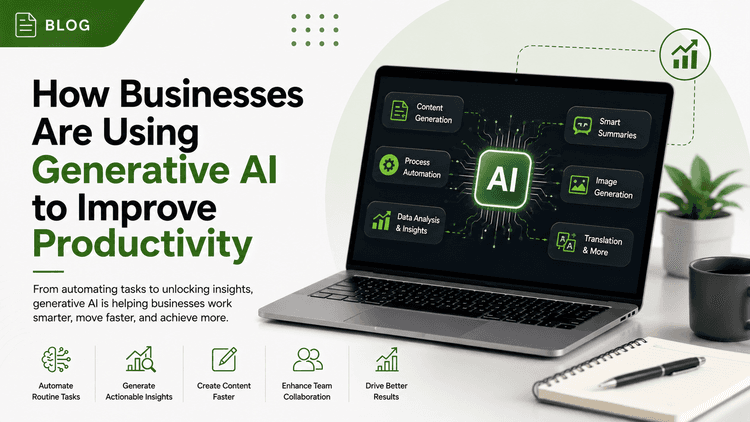
Table of Contents
Using artificial intelligence in businesses improves productivity across six core areas: content creation, software development, customer support, data analysis, process automation, and internal knowledge management. The results are measurable and accessible to companies of every size.
The key distinction is between businesses using AI tools as surface-level shortcuts and those deploying generative AI as a deliberate layer inside existing workflows. The second group sees the productivity gains that matter.
Key Takeaways
Generative AI in business delivers the biggest gains in marketing, software development, and customer support
Small businesses can implement AI without large upfront investment or a dedicated AI team
Targeted deployments outperform company-wide AI rollouts in productivity outcomes
AI reduces time on repetitive work and frees teams for decision-making and creative tasks
The right AI engineer determines whether a deployment becomes useful in production or stays a proof of concept.
How are Businesses Actually Using Generative AI to Improve Productivity?
Artificial intelligence in business has moved well past experimentation. Businesses using AI in production today are seeing measurable gains in output per team member, not just faster first drafts.
Content and marketing teams are using AI to produce first drafts, repurpose long-form content, write ad copy variations, and generate SEO briefs at a volume that was not possible with the same headcount before
Software development teams are using AI to generate boilerplate code, write unit tests, review pull requests, and explain legacy code, reducing the time each engineer spends on routine tasks
Customer support operations are deploying AI to draft responses, summarize tickets, and handle common queries at scale before they reach a human agent
Legal and compliance teams are using AI to review contracts, flag anomalies, and summarize documents, compressing what used to take hours into minutes
Operations teams are automating report generation, workflow routing, and data transformation without building custom integrations from scratch.
How Content Teams Use AI to Produce Faster
The most common AI use in business is content production. Work that took three days (a campaign brief, a blog post, and five ad variations) now takes less than a day. AI removes the time cost of the writing layer without touching the strategy or judgment.
How Developers Use AI to Ship Better Code
Developers using AI coding assistants spend significantly less time on tests, documentation, and boilerplate, and more time on architecture and product decisions. This directly improves how to use AI in business for engineering-heavy teams.
Should Small Businesses Invest in Generative AI for Productivity?
The honest answer is yes, but the entry point matters more than the tool.
According to the latest reports of Grand View Research, the global generative AI market was valued at USD 20.21 billion in 2024 and is projected to grow at a CAGR of approximately 37% through 2030, driven in part by small and mid-size businesses adopting AI faster than expected.
Small businesses report meaningful time savings on email drafting, social media, and customer communication that free up founder and team time for sales and product work
Entry cost is low: most AI productivity tools start under $50 per month per user
The biggest barrier is not cost but knowing which workflow to target first
Business Size | Recommended AI Entry Point | Immediate Productivity Gain |
Solo founder or freelancer | Writing assistant, meeting summarizer | 3 to 5 hours saved per week on communication and admin |
Small business (2 to 20 people) | Customer support AI, content tools | Faster response cycles, more content output per person |
Mid-size company (20 to 200 people) | Workflow automation, internal AI tools, code assist | Cross-department time savings across support, dev, and ops |
Enterprise | Custom AI builds, RAG pipelines, internal copilots | Measurable output-per-employee gains at scale |
What does Implementation of AI in Business Look Like for Small-Scale Enterprises?
The most successful AI for small businesses starts narrow. One workflow, one clear outcome. A small ecommerce brand automating customer support response. A SaaS startup generating first drafts of documentation. A service business summarizing client call notes before the follow-up is written. Each is a targeted use of AI in business that compounds over weeks.
Which AI Tools Deliver Results Without Enterprise Budgets
Off-the-shelf tools like Claude, ChatGPT, Notion AI, and GitHub Copilot cover most productivity needs without custom development. Custom builds become worth the investment once a specific workflow has been validated.
What Industries Are Seeing the Biggest AI Productivity Gains?
Industry | Primary AI Use Case | Reported Productivity Gain |
Marketing and advertising | Content production, campaign iteration, ad copy variation | 30 to 50% faster production cycles |
Software development | Code generation, testing, documentation | 20 to 40% reduction in time per engineering task |
Customer support | Response drafting, ticket summarization, tier-1 automation | 40 to 60% reduction in average handle time |
Legal and compliance | Contract review, document summarization | Hours-to-minutes per document cycle |
Healthcare administration | Clinical note drafting, patient summary generation | Significant reduction in documentation time per clinician |
Financial services | Report generation, analysis summaries, compliance checks | Faster turnaround on routine analysis tasks |
How do Businesses Measure the ROI of Generative AI on Productivity?
Most businesses that see no AI productivity gain deployed a tool without defining what success looks like in advance.
Set a baseline before AI: task duration, team members involved, error or rework rate
Track output volume change, not just time saved. AI often increases output capacity more than it reduces hours.
Measure quality separately from speed. Faster output that underperforms is not a productivity gain.
Leading vs Lagging Productivity Indicators for AI
Metric Type | What to Measure | When to Measure |
Leading (early signal) | Tasks completed per day, draft acceptance rate, AI usage rate per team | First 30 days after deployment |
Lagging (outcome) | Revenue per employee, customer response time, feature velocity | 60 to 90 days after deployment |
Quality | Error rate, rework requests, customer satisfaction score | Ongoing, monthly review |
For more on how to scale AI capacity without management overhead, read our guide on how to scale your development team without the management overhead.
Is Hiring an AI Engineer Worth It for Business Productivity?
For businesses ready to move from off-the-shelf tools to a custom build, yes. Hiring AI engineer leverages you build a system trained on your data, integrated with your workflows, and optimized for your specific productivity bottleneck.
Custom RAG pipelines that pull from your internal documentation or product knowledge base
Workflow automation connecting AI output directly to your existing systems without manual steps
Fine-tuned outputs that match your brand and internal standards
Evaluation frameworks that track whether AI output quality improves or degrades over time
Our guide on how much it costs to hire an AI developer covers what to budget and scope before you start.
Ready to move from AI tools to AI that works specifically for your business?
QuickHire’s GenAI engineering team connects you with a vetted engineer and dedicated PM in under 10 minutes. No contracts. Start today.
Your business should be using AI to gain real productivity today, not in a pilot that never ships.
QuickHire’s AI infrastructure engineers build the AI layer that fits inside your existing operations.
FAQs
How do businesses use artificial intelligence to increase productivity?
Generative AI helps businesses increase productivity by reducing the time spent on repeatable, output-driven tasks: first drafts, customer responses, data summarization, code boilerplate, and report generation. The gains compound when AI is integrated into an existing workflow rather than used as a standalone tool that requires a separate step.
How do small businesses use generative AI for productivity without a large budget?
Most small business AI use cases start with subscription tools under $50 per month. The most effective entry points are writing assistants for customer communication, AI meeting summarizers, and AI drafting tools for marketing content. Start with one workflow, measure the time saved, and expand from there.
What does it cost to implement generative AI for business productivity?
Off-the-shelf AI tools cost $20 to $100 per user per month. Custom integrations by an AI engineer range from $10,000 to $50,000 depending on complexity. Enterprise deployments with custom training and monitoring can exceed $100,000. The right starting point depends on whether your use case is covered by existing tools.
Should I hire an AI developer or use off-the-shelf AI tools for my business?
Start with off-the-shelf tools until you have validated a specific use case that existing products cannot handle well. Custom development makes sense when you need AI trained on proprietary data, integrated into internal systems, or producing outputs with specific constraints that generic tools cannot meet.
How long does it take for AI to show measurable productivity gains in a business?
Most businesses see early signals within 2 to 4 weeks of a targeted AI deployment. Meaningful output-volume gains appear by week 6 to 8. Company-wide improvements take longer because they depend on team adoption, not just tool access.
Concluding Thoughts
Using artificial intelligence in business for productivity is a present-day operational decision, not a future consideration. Businesses that start narrow, measure carefully, and expand from proven use cases are outpacing competitors who waited for a perfect strategy.
Start with the one repetitive task that costs your team the most time each week and measure it against a clear baseline. That is how AI use in business moves from pilot to production.