Top Frontend Frameworks to Watch in 2026
For most businesses, React + Next.js is the best frontend framework due to its large developer ecosystem, SEO advantages, scalability, and hiring flexibility. However, Angular is ideal for enterprise applications, Vue for developer-friendly projects, Astro for content-driven websites, and Svelte for performance-focused applications.
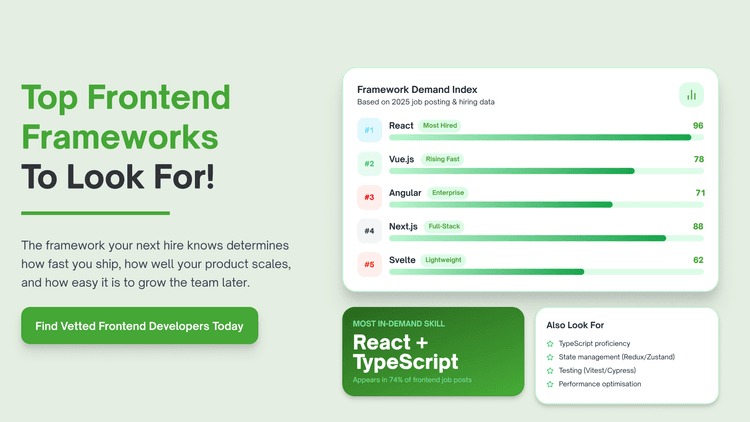
Table of Contents
Let's be honest. Every year, someone publishes a list of "top frontend frameworks," and every year it's basically the same recycled breakdown: React is popular, Angular is for enterprises, Vue is easy to learn. Done. See you next year.
That's not what this is.
In 2026, picking a frontend framework isn't just a technical call anymore. It's a business decision that touches how fast you ship, how much your team costs, how well your product holds up under real load, and whether you can actually find someone to build it without waiting three months. We're going to get into all of that.
Here's what we looked at before writing this: what the top-ranking articles are covering, what developers are actually debating on Reddit and Dev.to, and, importantly, what most of those articles quietly skip over. Spoiler: they skip the part that actually matters for most product teams.
What Most Articles Get Wrong About Frontend Frameworks
The typical "best frameworks 2026" post walks you through React's virtual DOM, Angular's opinionated structure, and then throws in Svelte for good measure. What they rarely talk about:
What happens when your current developer leaves mid-project and the framework has a small talent pool
The real cost difference between frameworks when you factor in hiring, onboarding, and maintenance
How Core Web Vitals compliance (which is now directly tied to SEO and user retention) changes which framework you should actually be using
What "framework fatigue" is doing to enterprise teams right now and why teams are making very different choices than they were in 2023
That's the stuff this post focuses on. Let's get into it.
What are the Top Frontend Frameworks That Actually Matter in 2026?
Not every framework deserves equal weight in this conversation. Some are genuinely production-ready with large talent pools behind them. Some are technically impressive but will cost you weeks of recruiting. And a couple are worth keeping an eye on without betting a product on them just yet. Here's the honest breakdown.
React + Next.js: Still the Default, But With a Catch
React hasn't just survived 2026. It still owns roughly 44-45% of the developer market. If you look at job boards, most frontend developer roles still list React first. Netflix, Airbnb, and countless mid-size SaaS companies run on it. The talent pool is enormous, which means if your lead dev walks out, you're not stuck.
But here's the catch most articles miss: in 2026, when people say they're "building with React," they almost always mean they're building with Next.js. The two have become inseparable for anything serious. Next.js handles server-side rendering, static generation, routing, and image optimization in ways that plain React can't, and those things matter a lot now that Google's Core Web Vitals are directly impacting how pages rank.
Who it's actually for: Teams that need to hire fast, products that need SEO to work, SaaS dashboards, real-time consumer apps, and anything that might need to scale quickly.
What to watch out for: Next.js comes with strong opinions about how you structure data fetching and rendering. That's helpful for consistency but can slow down teams who are new to it. And the ecosystem, while massive, means there are a hundred ways to solve any problem, which can cause decision fatigue.
The React Compiler released in recent cycles now automates a lot of the manual performance optimizations that used to require careful developer discipline. That's a genuinely useful shift.
Vue 3 + Nuxt: The One That's Easier to Love
If React has the biggest army, Vue has the best reputation among the people who actually use it. Vue 3's Composition API brought it closer to React's mental model while keeping the single-file component format that makes Vue so readable. Nuxt (Vue's meta-framework, the equivalent of Next.js for React) completes the picture with SSR, routing, and modern tooling baked in.
The developer experience here is genuinely better than people give it credit for. The documentation is considered the clearest in the frontend world. Learning curve is low. State management with Pinia is clean and predictable.
The honest tradeoff: Vue's job market in North America and Western Europe is smaller than React's. If you're building a product and need to hire multiple developers quickly, you'll feel that gap. Vue is stronger in Asian markets and in teams that value code clarity over raw talent availability.
Who it's actually for: Teams building their first serious product, companies working with tighter budgets where a junior developer needs to get up to speed fast, and any project where the codebase being readable matters long-term.
Angular 20: Enterprise Picks It for a Reason
Angular gets mocked a lot in casual developer discussions. "Too verbose." "Too opinionated." "Too much boilerplate." But sit inside a 60-person engineering org, and that "too opinionated" thing becomes the only reason the whole team is still shipping code at the same velocity.
Angular 20 (Google maintains a strict six-month release cycle) brought significant improvements in runtime performance through signals-based reactivity and zoneless change detection. For large enterprise dashboards, financial platforms, and internal tooling that need to run reliably for years, Angular's strict structure is a feature, not a bug.
Enterprise teams that chose Angular rarely switch. The migration cost is too high, and frankly, the reliability isn't worth abandoning. That stickiness is actually a healthy signal.
The gap no one talks about: Almost every article frames Angular as "for big companies." What they miss is that the consistency Angular enforces dramatically reduces onboarding time for new engineers. A Fortune 500 firm building a trading platform can onboard a developer across three continents to the same codebase because the conventions leave no room for creative interpretation. That's worth a lot.
Who it's actually for: Large teams, enterprise software, applications that will be maintained across multiple developer generations, banking, insurance, and government systems.
Svelte + SvelteKit: Small Footprint, Serious Momentum
Svelte continues to win on developer satisfaction. In multiple surveys it ranks at the top for "I want to keep using this" and "I enjoyed working with it." Usage sits around 7-8%, which sounds small until you understand what's happening: the teams using Svelte are choosing it intentionally and not going back.
The core idea behind Svelte is different from React or Vue. It compiles away at build time rather than running a framework in the browser. That means smaller bundle sizes, faster page loads, and genuinely better Core Web Vitals without a lot of engineering effort. Svelte 5 introduced runes, making reactivity more predictable and explicit.
SvelteKit adds everything a modern app needs: routing, SSR, static generation, and deployment adapters for almost any platform.
What's missing from most coverage: Nearly every article talks about Svelte's satisfaction scores and bundle size. Almost none of them talk about what happens when you need to hire for it. The talent pool is still limited. If you build a product on Svelte and need to scale your team in six months, you'll spend more time recruiting or training than a React team would. That's a real cost.
Who it's actually for: Performance-sensitive applications like e-commerce frontends, dashboards, and mobile-like web experiences where teams care deeply about page speed metrics and can afford to be deliberate about hiring.
Astro: The Framework Built for the Web, Not for the App
Astro is genuinely different and deserves more coverage than it gets in these lists. Most frameworks assume you're building a web application. Astro assumes you're building a website, and that distinction matters more than it sounds.
Astro defaults to shipping zero JavaScript unless you ask for it. For content-heavy websites like marketing sites, documentation hubs, and blog platforms, that's a massive performance win. When JavaScript is needed for interactive components, Astro lets you use React, Vue, or Svelte components inside the same project. That flexibility makes adoption much easier.
In 2026, Astro's Fonts API, Content Security Policy support, and Live Content Collections (from Astro 6) make it a surprisingly complete solution for content-focused work. It's showing strong results in developer surveys and rising adoption across the web.
The gap: Almost no competitor article talks about Astro in the context of SEO-driven marketing sites or product landing pages. Most "best frameworks" posts compare it unfairly on application features it was never designed for. Astro's strength is serving pages fast for content that exists to rank, convert, and load instantly.
Who it's actually for: Marketing teams building content hubs, product sites, documentation portals, and any situation where page speed has a direct impact on conversion or search ranking.
Qwik and SolidJS: The Ones Worth Watching
These two belong in the "worth understanding" category rather than "build your next product on this."
SolidJS takes React's component model but replaces the virtual DOM with fine-grained reactivity. It's faster than React in most benchmarks. The mental model is familiar to anyone who knows React. The ecosystem is growing but still thin.
Qwik introduces a concept called "resumable" architecture. Instead of hydrating the entire page on load (which is what React and Angular do, and why JavaScript-heavy sites can feel sluggish even with SSR), Qwik loads only the code for the specific interaction the user is performing. The theory is sound. The practice is still early. Developer surveys show growing interest, but production adoption remains limited.
Neither is a primary recommendation for a business-critical product in 2026. Both are worth building a side project with if you want to understand where frontend performance is heading.
What is the importance of Choosing the Right Frontend Framework?
Here's the thing that separates teams that ship from teams that stall: Who is going to build this, and can you actually find them? Most framework comparison articles treat this as a footnote. It isn't. It's often a deciding factor.
React has the largest talent pool. Angular has a strong enterprise pipeline. Vue is harder to staff in Western markets. Svelte and SolidJS require recruiting developers who specifically know them or training React developers. Astro is niche enough that you're mostly hiring general frontend developers and training them.
If you're a startup making your first hire, that changes the calculus completely. A framework that's "better on benchmarks" doesn't matter if you spend four months trying to find someone who knows it.
Teams building speed also need to think about what happens when a developer leaves mid-project. With React, you can post a role and have candidates in days. With a smaller framework, you're reposting and hoping. That's not theoretical risk, it's something that actually happens to companies. For help with an existing site, explore our website maintenance and frontend support services.
For teams that need specialized Frontend Developer talent quickly, the framework choice and the hiring strategy need to be planned together, not separately.
TypeScript Is No Longer Optional
One thing that genuinely shifted in 2025 into 2026 is TypeScript reaching the top position by contributor count on GitHub. That tells you something important: typed codebases are now standard, not advanced.
Every major framework either requires TypeScript (Angular) or strongly recommends it (Next.js, SvelteKit, Nuxt). If you're building a product that more than two engineers will touch, TypeScript is the difference between a codebase that scales and one that starts accumulating silent failures.
This also matters for teams using AI-assisted development. TypeScript makes AI-generated code easier to validate, catch errors in, and improve. Developers who understand the framework deeply can guide AI tooling effectively. Those who don't are shipping bugs they can't see.
The Framework Fatigue Problem
There's a real and underreported phenomenon happening in enterprise teams right now. After years of chasing whatever was trending on GitHub, larger organizations are actively moving away from "newest and most innovative" toward "ships fast, backward compatible, low maintenance cost."
Core Web Vitals compliance (now tied to legal accessibility requirements in many countries under WCAG 2.2) means the performance argument for newer frameworks is real. But stability and backward compatibility have become equally weighted factors.
Teams are not evaluating frameworks based on GitHub stars anymore. They're asking: How much will it cost to maintain this in three years? How quickly can we hire for it? Will it break when a major version ships? The answers to those questions point squarely at React/Next.js and Angular for production systems, with Vue as a solid third choice for teams that invest in it early.
Which Framework Should You Actually Use?
Here's the honest answer: there isn't one. But here's a practical breakdown:
You're building a SaaS product or consumer app that needs to scale: React + Next.js. Every time. Talent availability alone justifies it.
You're building a large enterprise internal system that dozens of developers will touch over years: Angular. The conventions it enforces are the point.
You're building a content-heavy marketing site or documentation hub: Astro. It will outrank and outperform anything built with a heavier framework by default.
You're a smaller team that values developer experience and code clarity: Vue 3 + Nuxt. Just be intentional about your hiring strategy.
You're optimizing for raw performance and have a tight team: Svelte + SvelteKit. Know the hiring tradeoff upfront.
Conclusion
Most teams pick up a framework and then figure out who will build it. The better sequence is the other way around. Know who you can hire, what they're good at, what your timeline is, and then match the framework to those constraints.
This is especially true for teams moving fast. A React Developer who's shipped five production apps will outperform a theoretically superior framework of choice with no available talent every single time.
And if your situation involves inheriting a codebase mid-project or scaling a team quickly to hit a deadline, the framework choice you made six months ago is only as good as the people you can get in front of it right now.
The frontend framework conversation in 2026 is less about which is technically superior and more about which one fits your team, your timeline, your hiring market, and the specific type of product you're building. React remains the safest default. Angular is the enterprise standard. Astro is quietly doing things that other frameworks can't for content-first work. And Svelte is the one developer genuinely enjoy.
Pick the one that fits your reality. Ship. Iterate. The framework isn't the product.
Frequently Asked Questions
1. Is React still worth learning in 2026 or is it becoming outdated?
React is nowhere close to outdated. With roughly 44-45% market share and the largest talent pool of any frontend framework, it remains the safest investment for both developers and product teams. What changed is that React alone is rarely enough now. Most serious projects pair it with Next.js for server-side rendering and SEO. If you're choosing one framework to learn for job prospects, React + Next.js is still the answer in 2026.
2. Which frontend framework is easiest to hire developers for right now?
React has the deepest hiring pool by a significant margin. Most frontend developers have React experience, and most job listings require it. Angular comes second for enterprise roles specifically. Vue, Svelte, and Astro have smaller talent pools, which means longer hiring timelines and sometimes higher costs for specialized skill. If hiring speed matters to your product timeline, that alone can decide your framework choice before any technical evaluation happens.
3. Does the frontend framework you choose affect your website's SEO?
Yes, more than most people realize. Frameworks that ship heavy client-side JavaScript without server-side rendering can hurt how search engines crawl and index your pages. Google's Core Web Vitals scores directly affect rankings, and those scores are heavily influenced by how fast your pages load and become interactive. Next.js, Nuxt, SvelteKit, and Astro all handle server-side rendering. Astro in particular ships zero JavaScript by default, which makes it the strongest choice for content-heavy pages where organic ranking is the primary goal.
4. What is framework fatigue and is it affecting which frameworks teams choose in 2026?
Framework fatigue is what happens when developers and engineering teams burn out from constantly switching to whatever framework is trending. In 2026, it's pushing enterprise teams away from chasing new tools and toward frameworks with stable APIs, predictable release cycles, and low migration risk. Angular benefits from this because Google's six-month release schedule is transparent and backward compatible. React and Next.js benefit because their ecosystem is so established that teams know what to expect. The fatigue is real, and it's one reason smaller experimental frameworks struggle to get production adoption even when their technical story is compelling.
5. Should startups use a different frontend framework than enterprises?
Generally, yes, but not for the reasons most articles give. Startups need to move fast, hire quickly, and change direction without massive rewrites. That points toward React + Next.js almost every time because the talent availability and ecosystem support eliminates a lot of friction. Enterprises need consistency across large teams over long-time horizons, which is why Angular's opinionated structure becomes an asset rather than a limitation. Vue is a reasonable middle ground for growing teams that prioritize code clarity and developer experience over raw hiring volume.
6. How does AI-assisted development change which frontend framework you should use in 2026?
AI coding tools like GitHub Copilot generate more useful output for frameworks with large training datasets, which means React and Angular get better AI assistance than smaller frameworks simply because there's more code for models to learn from. TypeScript also plays a role here.
Typed codebases make it easier to validate, correct, and build on AI-generated code rather than accepting it blindly.
Teams using AI tooling heavily will find the combination of React or Angular with TypeScript gives them the most reliable AI pair-programming experience. Knowing your framework deeply still matters though. AI generates the code, but it's a developer's understanding of the framework that catches what the AI gets wrong.