The Enterprise Customer Wants An Update By Tomorrow Morning
Your biggest client wants answers by tomorrow, and you don't have them yet. Here's why enterprise escalations spiral fast, and how to respond before churn risk grows.
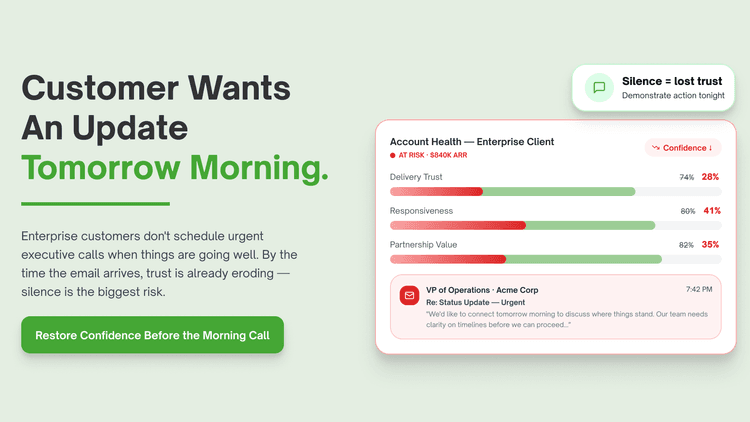
Your enterprise customer wants an update by tomorrow morning. You don't have the full picture yet. The clock is already running.
This happens to growing companies more often than anyone admits. Enterprise accounts expect answers faster than most teams can produce them. Most escalations get worse from silence, not from the original problem.
Top custom stack enterprise escalation issues and how to resolve them
You don't know the full scope of what broke yet
You open your inbox Monday morning. The client's email is short and direct. They want a root cause by tomorrow.
What is happening: Your team is still investigating internally. Support has partial information. Engineering has a different partial picture.
What most teams miss: Most teams respond before they understand the full scope. A confident guess that turns out wrong damages trust worse than a delay.
Business impact: Enterprise churn after a mishandled incident can cost far more than the original bug ever did.
Industry trend: According to Gainsight's customer success research, poor incident communication is a leading driver of enterprise churn.
How to fix it:
Set up an incident channel in Slack with engineering, support, and account management together.
Assign one single point of contact for all customer communication.
Document a clear timeline of what is confirmed versus still unknown.
And the worst part? You had no warning. The client noticed before your dashboard did.
This is the step most teams skip. Forward pull: Even with scope clear, the next challenge is saying it the right way.
Your update sounds like you're hiding something
What is happening: Your first response uses vague language. The client reads between the lines. They assume the problem is worse than you're saying.
What nobody tells you is this: Most teams soften bad news instinctively. Vague language reads as evasive, not reassuring, to enterprise buyers.
Business impact: A single vague update can escalate a technical issue into an executive level relationship problem.
Industry trend: Research suggests transparency during incidents correlates directly with retained enterprise trust, according to multiple customer success benchmarks.
How to fix it:
State exactly what you know, in plain language, with no hedging.
Name what you don't know yet instead of avoiding it.
Give a specific time for the next update, not "soon."
Nobody tells you this upfront. You find out when the client escalates higher.
Forward pull: Sometimes the message is fine, but nobody senior enough delivered it.
The wrong person is talking to the client right now
You open your dashboard Monday morning. Support has been replying to the enterprise account all weekend. The client is asking for someone with authority.
What is happening: A junior team member is handling a high stakes escalation alone. The client wants to know leadership is aware. Nobody senior has joined the conversation yet.
What most teams miss: Most teams let the original responder keep ownership by default. Enterprise clients expect visible leadership involvement during real incidents.
Business impact: A missing leadership presence during escalation directly increases the chance of contract non renewal.
Industry trend: According to Gainsight's enterprise churn research, executive involvement during incidents measurably improves retention outcomes.
How to fix it:
Loop in a VP or founder for any account above a defined revenue threshold.
Have leadership send a direct, personal message within the first few hours.
Keep the original responder involved for continuity, not replaced entirely.
That is the part that actually hurts. The client wanted to feel heard. They felt managed instead.
Forward pull: Even with the right people involved, the technical fix still has to actually happen.
Nobody on your team can fix the root cause fast enough
What is happening: The bug spans systems your usual team doesn't fully own. Diagnosis is taking longer than the client's deadline allows. Internal debate slows decisions further.
What most teams miss: Most teams try to solve everything internally first. A specialist outside the team often diagnoses unfamiliar systems faster.
Business impact: Every hour without a fix increases the risk the client escalates to their own leadership or starts evaluating alternatives.
Industry trend: According to Atlassian's incident management research, time to resolution is the single biggest driver of customer trust during outages.
How to fix it:
Identify whether the issue needs infrastructure, integration, or application level expertise.
Bring in outside help the moment internal progress stalls.
Give the client a realistic fix window based on actual diagnosis, not hope.
Most developers know this. Most do not fix it.
Forward pull: A fix without a clear explanation still leaves the client uneasy.
You can explain the fix but not why it happened
What is happening: The immediate issue is resolved. The client asks why it happened. Your team can't fully explain the root cause yet.
What nobody tells you is this: Most teams treat the fix as the finish line. Enterprise clients care more about prevention than the patch itself.
Business impact: An unexplained root cause leaves the client wondering if the same issue will happen again next quarter.
Industry trend: Research suggests post incident transparency reduces repeat escalation rates significantly across enterprise SaaS relationships.
How to fix it:
Run a formal postmortem within 48 hours of resolution.
Share a written root cause summary directly with the client.
Include specific prevention steps, not general reassurance.
It sounds obvious. Almost nobody does it.
Forward pull: Even a clear postmortem won't help if the next update is also late.
Your promised update deadline slips, and trust slips with it
What is happening: You promised an update by tomorrow morning. Tomorrow morning arrives with nothing new to share. The client notices the silence immediately.
What most teams miss: Most teams wait until they have a full answer before updating. A short, honest update without a full answer still works.
Business impact: A missed deadline, even a minor one, compounds doubt that was already building from the original incident.
Industry trend: According to customer success benchmarks from Gainsight, missed communication commitments are cited as a top reason for enterprise dissatisfaction.
How to fix it:
Send an update at the promised time, even if it's "still investigating, next update at 3pm."
Build update cadence into your incident process, not just the fix itself.
Never let a deadline pass in silence, regardless of progress made.
This is the step most teams skip. A missed update hurts more than a delayed fix.
Forward pull: Even perfect communication can't replace having the right expert from the start.
You don't have the right expertise on call when it matters
What is happening: The issue needs specific technical depth your team doesn't have in house. Hiring would take weeks. The client's deadline is tomorrow.
What nobody tells you is this: Most teams treat specialist hiring as a long term decision. Escalations need expertise on a timeline measured in hours.
Business impact: Every escalation without the right expertise risks turning one bad night into a lost enterprise contract.
Industry trend: According to Gainsight's research on enterprise retention, response speed during critical incidents directly predicts renewal likelihood.
How to fix it:
Identify the exact technical gap before searching for help.
Have a fast path to bring in a specialist without a lengthy hiring process.
Brief the specialist with full context so they can move immediately.
And the worst part? You had no warning. By the time you found help, the deadline had already passed.
The real problem behind all of these issues
Every issue above comes from the same root cause. You're missing the right expertise at the exact moment a client's trust is on the line. Enterprise relationships don't wait for a slow hiring process. The fix isn't more internal pressure. It's faster access to the right person.
How QuickHire fixes this
When an enterprise customer escalates and the clock is running, you need a senior engineer who can diagnose unfamiliar systems fast under pressure. QuickHire connects you in minutes. Traditional hiring takes weeks. QuickHire provides on-demand technical, QA and DevOps support, with a Project Manager assigned within 10 minutes.
You pay for what you use. No salary. No contract. A specialist can join your incident channel, review logs, and help your team reach a root cause before the next deadline.
This isn't about replacing your team's relationship with the client. It's about giving them the answer they're waiting for.
Conclusion: Enterprise customers expect speed your internal team can't always deliver alone. The right specialist can help you meet that deadline. Hire a vetted custom stack expert on QuickHire today. No contracts. No wait.
Frequently asked questions
How do I respond to an enterprise customer demanding an update fast?
State exactly what you know, name what's still unknown, and give a specific time for the next update. Avoid vague language that reads as evasive.
Should leadership get involved in a customer escalation?
Yes, for high value accounts, a VP or founder should join the conversation directly within the first few hours. Visible leadership measurably improves retention during incidents.
How do I find the root cause of an issue fast enough for a client deadline?
Identify whether the problem needs infrastructure, integration, or application expertise, then bring in outside help immediately if internal progress stalls. QuickHire can connect you with a specialist who can join your incident response within minutes.
What should I do if I can't meet a promised update deadline?
Send an honest update anyway, even without a full answer, instead of staying silent. A short update beats a missed deadline every time.
How do I prevent enterprise churn after a major incident?
Run a formal postmortem within 48 hours and share a clear root cause summary with the client. QuickHire experts can help diagnose the root cause fast enough to support that timeline.