Enterprise Customer About To Churn? Here's What CTOs Do In The First 24 Hours
Your biggest customer is threatening to leave, and the next 24 hours decide what happens. Here's what CTOs actually do first, and why it works.
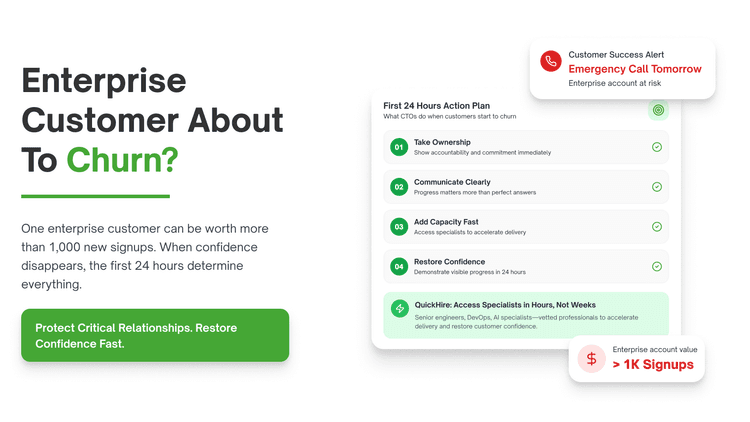
Your enterprise customer is about to churn. You have roughly 24 hours to change that outcome. What you do first matters more than what you eventually fix.
This happens to growing companies more than anyone admits. The first day after a churn signal decides whether the relationship survives. Most CTOs who save the account do the same handful of things immediately.
Top custom stack enterprise churn response issues and how to resolve them
You don't know exactly why they're threatening to leave
You open your inbox Monday morning. The client's message is angry but vague. You're not sure which specific failure triggered it.
What is happening: The complaint references frustration, not a clear incident. Your team has several theories. Nobody has confirmed the actual root cause yet.
What most teams miss: Most teams respond to the tone of the message. The real fix requires responding to the specific cause underneath it.
Business impact: Misdiagnosing the actual complaint wastes the limited trust you have left to work with.
Industry trend: According to Gainsight's churn research, misunderstood root causes are a common reason early retention efforts fail.
How to fix it:
Request a short call within the first few hours to clarify specifics.
Pull account history, tickets, and usage data before that call.
Confirm the root cause directly with the client before proposing any fix.
And the worst part? You had no warning. The frustration had been building quietly.
This is the step most teams skip. Forward pull: Even with the cause clear, the first response still has to land right.
Your first response sounds defensive instead of accountable
What is happening: Your team's reply explains why the issue happened. The client reads it as an excuse. The conversation gets worse instead of better.
What nobody tells you is this: Most teams lead with context to protect themselves. Clients in this moment want ownership first, context second.
Business impact: A defensive first response can turn a fixable issue into a leadership level escalation within hours.
Industry trend: Research suggests accountable, ownership first communication correlates strongly with retained trust during account crises.
How to fix it:
Open with a direct acknowledgment of the impact, not the cause.
Save technical explanation for a follow up message, not the first one.
State a clear next step and a specific time for the next update.
Nobody tells you this upfront. You find out when the reply makes things worse.
Forward pull: Sometimes the message is right, but the wrong person sent it.
Nobody senior has personally reached out yet
You open your dashboard Monday morning. Support has handled every message so far. The client hasn't heard from anyone with real authority.
What is happening: A high value account is at risk. The original responder lacks the authority the client expects in this moment. Leadership hasn't engaged directly.
What most teams miss: Most teams let support keep ownership by default. Enterprise clients expect visible leadership when churn risk is real.
Business impact: A missing leadership response during a churn signal directly lowers the odds of saving the account.
Industry trend: According to Gainsight's enterprise retention research, executive involvement during at risk accounts measurably improves save rates.
How to fix it:
Have a founder or VP personally call the client within the first 24 hours.
Keep the original team member involved for continuity, not sidelined.
Make the leadership outreach specific, not a generic check in.
That is the part that actually hurts. The client wanted to feel important. Nobody senior showed up.
Forward pull: Even leadership attention won't help if the underlying fix is taking too long.
The technical fix is taking longer than the client's patience
What is happening: Engineering is working on the root cause. Progress is real but slow. The client's patience is running out faster than the fix is completing.
What most teams miss: Most teams wait for a full fix before updating the client. A clear interim update buys far more time than silence does.
Business impact: A slow visible fix without communication damages the relationship as much as the original issue did.
Industry trend: According to Atlassian's incident management research, perceived response speed matters as much as actual resolution speed.
How to fix it:
Identify whether the fix needs internal expertise or outside specialist help.
Bring in additional support immediately if internal progress has stalled.
Share interim progress with the client every few hours, not just at completion.
Most developers know this. Most do not fix it.
Forward pull: A fast fix still needs proof it will actually hold.
You can't yet prove this won't happen again
What is happening: The immediate issue is resolved. The client asks what prevents a repeat. Your team doesn't have a concrete answer ready yet.
What nobody tells you is this: Most teams treat the fix as the finish line. Enterprise clients weigh prevention more heavily than the fix itself.
Business impact: Without a credible prevention plan, the client has no reason to believe the relationship is actually safer now.
Industry trend: Research suggests prevention focused follow up significantly reduces repeat escalation rates in enterprise accounts.
How to fix it:
Draft a specific prevention plan within the first 24 hours, even if brief.
Include monitoring or process changes, not just the technical patch.
Share it proactively rather than waiting for the client to ask again.
It sounds obvious. Almost nobody does it.
Forward pull: Even a strong prevention plan can't help if your team can't deliver it consistently.
Your team's updates are inconsistent across different people
What is happening: Support tells the client one thing. Engineering tells them something slightly different. The client notices the mismatch immediately.
What most teams miss: Most teams let multiple people communicate freely during a crisis. Inconsistent messaging reads as disorganization to a watching client.
Business impact: Conflicting updates during a churn risk situation actively erodes the trust you're trying to rebuild.
Industry trend: According to customer success benchmarks from Gainsight, communication consistency is a top factor in retention during account crises.
How to fix it:
Assign one single point of contact for all client communication immediately.
Brief that person fully before every message goes out.
Route all internal updates through one shared incident channel first.
This is the step most teams skip. Mixed messages cost more trust than slow ones.
Forward pull: Even consistent messaging can't save the account without the right expertise behind it.
You don't have the right specialist available in the first 24 hours
What is happening: The root cause needs specific technical depth your team lacks in house. Hiring would take weeks. The churn risk window is measured in hours.
What nobody tells you is this: Most teams treat specialist hiring as a long term decision. Churn prevention needs expertise on a timeline measured in hours, not weeks.
Business impact: Every hour without the right expertise increases the odds the client moves to evaluating alternatives.
Industry trend: According to Gainsight's research on enterprise retention, response speed during the first 24 hours directly predicts whether an account is saved.
How to fix it:
Identify the exact technical gap before searching for outside help.
Have a fast path to bring in a specialist without a lengthy hiring process.
Brief them with full context so they can contribute within the same day.
And the worst part? You had no warning. By the time you found help, hours of the window were already gone.
The real problem behind all of these issues
Every issue above comes from the same root cause. The first 24 hours after a churn signal require speed your internal team can't always provide alone. Custom stacks make every technical fix unique to your setup. The fix isn't more internal pressure. It's faster access to the right expertise.
How QuickHire fixes this
When an enterprise account signals churn risk, you need a senior engineer who can diagnose and fix unfamiliar issues fast under pressure. QuickHire connects you in minutes. Traditional hiring takes weeks. QuickHire offers on-demand engineering support in 10 minutes, working in 4-hour or 8-hour sessions.
You pay for what you use. No salary. No contract. A specialist can join your incident response, help confirm the root cause, and support a fix within the same critical window.
This isn't about replacing your account team's relationship with the client. It's about giving them a real fix to point to.
Conclusion: The first 24 hours after a churn signal decide what happens next. The right specialist can help you use that window well. Hire a vetted custom stack expert on QuickHire today. No contracts. No wait.
Frequently asked questions
What should I do first when an enterprise customer threatens to churn?
Confirm the specific root cause before responding, and lead with accountability rather than explanation. Get a senior team member involved within the first few hours.
Should a CEO or CTO personally contact a customer at risk of churning?
Yes, for high value accounts, leadership involvement within the first 24 hours measurably improves the odds of saving the relationship. Keep the original team member involved too.
How do I fix a technical issue fast enough to save an enterprise account?
Identify whether the fix needs internal or outside expertise, then bring in additional support immediately if progress has stalled. QuickHire can connect you with a specialist who can join your response within minutes.
What should I tell a client after fixing the issue that caused them to consider leaving?
Share a specific prevention plan, not just confirmation that the immediate issue is resolved. Clients weigh prevention more heavily than the original fix.
Who should I call when I have 24 hours to prevent an enterprise customer from churning?
Bring in a specialist immediately rather than relying solely on your internal team's bandwidth. QuickHire connects you with a vetted custom stack expert who can help confirm the fix fast.