Checkout Stopped Working Overnight
Checkout stopped working overnight, and orders aren't coming through. Here's why custom stack checkouts fail without warning, and how to fix it fast.
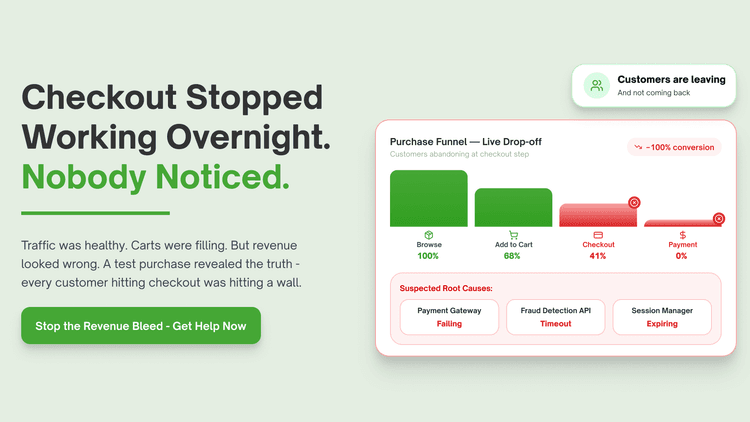
Checkout stopped working overnight. You wake up to silence instead of order notifications. Your storefront looks completely normal.
This happens across custom stacks more than anyone wants to admit. Checkout depends on multiple systems working together perfectly. One small failure anywhere in that chain stops every transaction.
Top custom stack checkout issues and how to resolve them
Your payment gateway is rejecting valid transactions
You open your dashboard Monday morning. Three orders failed overnight. Your payment gateway looks fine on the surface.
What is happening: Your gateway is silently declining valid cards. The error response gives no clear reason. Customers see a generic failure message.
What most stores miss: Most teams assume gateway downtime causes checkout failures. Silent declines from fraud rules cause far more damage.
Business impact: Even a small percentage of false declines can cost thousands in lost revenue during a single bad night.
Industry trend: According to Stripe's own documentation, overly aggressive fraud rules are a common cause of legitimate transaction declines.
How to fix it:
Check your gateway's decline codes in the dashboard, not just your own logs.
Review fraud filter sensitivity settings in Stripe or Braintree.
Add a fallback payment processor for redundancy during outages.
And the worst part? You had no warning. The declines looked random until you checked.
This is the step most teams skip. Forward pull: Even with payments working, the cart itself can quietly break first.
Your cart total stopped calculating correctly
What is happening: Tax, shipping, or discount logic produces the wrong total. Customers see a number that doesn't add up. Some abandon before completing checkout.
What nobody tells you is this: Most teams test cart logic once at launch. Tax rules and shipping rates change more often than code gets revisited.
Business impact: Incorrect totals at checkout directly drive cart abandonment, according to Baymard Institute research on checkout usability.
Industry trend: Baymard's checkout research consistently ranks unexpected costs among the top reasons customers abandon a cart.
How to fix it:
Audit your tax calculation logic against current rates using TaxJar or Avalara.
Test shipping rate calculations across every supported region quarterly.
Log every cart total calculation for thirty days to catch silent errors.
Nobody tells you this upfront. You find out when refund requests start coming in.
Forward pull: Sometimes the math is right, but the order never reaches your system at all.
Orders are completing but never reaching your system
You open your dashboard Monday morning. The payment processor shows successful charges. Your order management system shows nothing.
What is happening: A webhook between your payment processor and your backend is failing silently. The charge succeeds. The order record never gets created.
What most stores miss: Most teams assume successful payment means a successful order. Webhook failures break that link without any visible error.
Business impact: Customers get charged without receiving a confirmation, creating support tickets and trust damage at once.
Industry trend: Research suggests webhook delivery failures are a common but underreported cause of order sync issues across custom integrations.
How to fix it:
Set up webhook retry logic with exponential backoff.
Log every webhook event received, with timestamps, for audit purposes.
Add a reconciliation job comparing processor charges against order records daily.
That is the part that actually hurts. Customers got charged. You had no idea.
Forward pull: Even working webhooks can't help if the checkout page itself won't load.
Your checkout page is timing out under normal traffic
What is happening: The checkout page takes too long to load. Some customers give up before it finishes. Server response times spike without an obvious cause.
What most stores miss: Most teams optimize the homepage and product pages. Checkout itself rarely gets the same performance attention.
Business impact: Every extra second of checkout load time measurably increases abandonment, based on Google's page speed research.
Industry trend: Google's research on page speed shows conversion rates drop sharply as load time increases past a few seconds.
How to fix it:
Profile checkout page load times using Lighthouse or WebPageTest.
Reduce synchronous calls to third-party scripts during checkout.
Cache static checkout assets aggressively through your CDN.
Most developers know this. Most do not fix it.
Forward pull: A slow checkout is bad. A checkout that silently fails validation is worse.
Form validation is blocking valid customer input
What is happening: A customer enters a valid address. The form rejects it anyway. They retry several times before giving up entirely.
What nobody tells you is this: Most teams write validation rules for common cases. International addresses or unusual formats often break rigid rules.
Business impact: Validation errors that block valid input cause abandonment exactly at the final step of the funnel.
Industry trend: Baymard Institute's checkout usability research identifies overly strict form validation as a frequent abandonment trigger.
How to fix it:
Test your address and card validation against international formats.
Loosen regex patterns that reject valid but unusual input.
Add clear, specific error messages instead of generic "invalid input" text.
It sounds obvious. Almost nobody does it.
Forward pull: Sometimes the checkout breaks for reasons that have nothing to do with your code.
A third-party script is blocking checkout from loading
What is happening: An analytics or marketing script fails to load. Your checkout page waits on it anyway. The whole page stalls behind one slow script.
What most stores miss: Most teams add tracking scripts without testing failure scenarios. One blocked script can freeze an entire checkout flow.
Business impact: A frozen checkout page converts at zero, no matter how good the rest of your funnel performs.
Industry trend: According to Google's Core Web Vitals guidance, third-party scripts are a leading cause of render blocking delays.
How to fix it:
Load all non-essential scripts asynchronously using async or defer.
Set timeouts on third-party script loading so checkout never waits indefinitely.
Audit your script tags using Chrome DevTools' network panel.
This is the step most teams skip. One tracking pixel took down checkout.
Forward pull: Even a fast, clean checkout can still fail if nobody catches the break in time.
Nobody catches the failure until customers complain
What is happening: Checkout has been broken for hours. No alert fired. The first sign of trouble is a support ticket or a revenue drop.
What nobody tells you is this: Most teams monitor server uptime. Checkout can be technically "up" while still failing every transaction.
Business impact: Every hour of undetected checkout failure is an hour of lost revenue you can't recover.
Industry trend: According to the DORA State of DevOps report, faster detection directly reduces total incident impact.
How to fix it:
Set up synthetic monitoring that completes a full test checkout every few minutes.
Alert on order volume drops, not just server errors.
Bring in a specialist who can diagnose the failure fast when it happens.
And the worst part? You had no warning. By the time you noticed, orders had already stopped.
The real problem behind all of these issues
Every issue above comes from the same root cause. Checkout depends on too many moving parts for one team to monitor alone. Custom stacks make this worse because every integration point is unique. The fix isn't more alerts. It's faster expertise the moment something breaks.
How QuickHire fixes this
When checkout stops working overnight, you need a backend or payments specialist who has debugged custom checkout flows before. QuickHire connects you in minutes. Traditional hiring takes weeks. QuickHire offers ecommerce support services that fix checkout the same day, in 4-hour or 8-hour sessions.
You pay for what you use. No salary. No contract. A specialist can trace the failure across your gateway, webhooks, and order system to find the exact break point.
This isn't about replacing your team. It's about getting checkout back online before revenue keeps slipping.
Conclusion: Checkout failures cost revenue every minute they go unresolved. The right specialist can find the break point fast and restore orders. Hire a vetted custom stack expert on QuickHire today. No contracts. No wait.
Frequently asked questions
Why did checkout stop working overnight with no code changes?
Common causes include silent payment declines, failed webhooks, or a third-party script blocking the page. Check your payment processor's dashboard first, then your webhook logs.
How do I know if my checkout failure is a payment gateway issue?
Compare your gateway's transaction logs against your own order records. A mismatch usually points to a webhook or integration failure, not the gateway itself.
Why are customers getting charged but orders aren't showing up?
This usually means a webhook between your payment processor and order system is failing silently. Add reconciliation checks to catch this automatically.
What should I do when checkout breaks and I can't find the cause?
Check payment logs, webhook delivery, and third-party scripts in that order. QuickHire can connect you with a specialist who debugs this exact scenario within minutes.
How can I prevent checkout failures from going unnoticed for hours?
Set up synthetic monitoring that runs a real test checkout regularly, and alert on order volume drops. QuickHire experts can help configure this kind of monitoring before the next failure hits.